MSP Visibility Is Not Vanity: Why the Market Has to See You Before It Buys From You

Listen to this article
Browser text-to-speech
Methodology: Fox & Crow Instinct analyzed publicly observable web, social, review, hiring, DNS, census, and technology signals for 13,627 U.S. MSPs in 2026. Revenue bands are staff-based proxies: 1–10 staff ≈ sub-$1M; 11+ staff ≈ above $1M. Unless noted, statistics refer to this dataset.
Table of Contents
- The Market Decides Before You Pitch
- What MSP LinkedIn Strategy Has to Do With Revenue
- The MSP Digital Footprint Problem Most Owners Ignore
- Why MSP Market Visibility Compounds Over Time
- Where to Start Building MSP Market Visibility
- What the Data Tells Us
- FAQ
Your MSP isn't losing deals because your service is bad.
It's losing deals because nobody knew you existed when the buying conversation started.
That's the visibility problem. And it's a revenue issue, not a vanity issue.
MSP visibility is the degree to which your ideal prospects encounter your name, your thinking, and your reputation before they ever pick up the phone to request a quote. If that encounter never happens, you don't get a shot. The prospect calls whoever showed up in the search results, whoever they saw posting on LinkedIn last week, whoever a peer mentioned at a chamber luncheon.
This post answers one specific question: why does MSP market visibility matter, and what does it cost your MSP business when you don't have it? I cover the broader go-to-market problem in depth in my guide to the MSP growth ceiling, but here, we're focused on visibility specifically.
The Market Decides Before You Pitch
Most MSP founders believe the sales process starts when a prospect calls them.
It doesn't.
The sales process starts the moment a business owner types a search query, asks a peer for a recommendation, or scrolls past a LinkedIn post and sees a name they half-recognize.
By the time a prospect calls you, they've already formed an opinion. Either they have one, or they don't, and if they don't have one about your MSP, you're starting from zero trust against competitors who've been showing up consistently.
Zero trust is a recoverable position. It just costs you time, discounts, and deals you'll never know you lost.
Buyers don't award managed services contracts to strangers if they can help it. They award them to names that feel familiar. Familiar doesn't mean famous. It means: "I think I've seen their stuff before."
That half-recognition is what MSP visibility buys you.
"The MSP that waits to be discovered is playing a game where the other team writes the rules. You don't get considered for deals you're invisible for. By the time a prospect calls you cold, they've already decided who they trust — and that decision happened somewhere your MSP wasn't showing up."
 Quote: Ian Richardson on MSP visibility and revenue
What MSP LinkedIn Strategy Has to Do With Revenue
LinkedIn is the one platform where your MSP's target buyers — operations managers, CFOs, business owners — are actively thinking about their businesses.
Not passively scrolling. Thinking.
That makes MSP LinkedIn strategy different from any other channel your MSP might use. Cold email lands in an inbox during someone's task-processing mode. A LinkedIn post lands in a feed during someone's thinking mode. Those aren't the same.
Here's what a basic MSP LinkedIn strategy looks like in practice:
- Your MSP page posts consistently, not daily, but on a predictable cadence. Two to three times a week is enough to stay visible without burning out whoever writes the content.
- Your founder or vCIO posts in their own voice, talking about the problems your clients face, the mistakes your MSP has seen, the decisions you've helped businesses make. Not product announcements. Not awards. Problems and decisions.
- Your team engages with prospect content, commenting meaningfully on posts from people inside your ICP before those people ever see your name in their DMs.
One client I worked with had been cold calling for two years with decent results. When they added a basic LinkedIn presence — the founder posting twice a week about common SMB IT mistakes — they started getting callbacks on cold outreach that previously went dead. The prospect had seen the name. That was enough to turn a cold call into a warm one.
MSP LinkedIn strategy isn't about building a following. It's about making your MSP's name familiar to the people you're going to call anyway.
 MSP LinkedIn strategy illustration showing consistent business-focused posting
The MSP Digital Footprint Problem Most Owners Ignore
Google your own MSP.
Not your company name. Google the problem your best client had before they hired you.
"IT support for construction companies [your city]." "Managed IT services for law firms [your city]." Whatever your ICP looks like.
If your MSP doesn't appear in the first page of results, you have a digital footprint problem.
Your MSP digital footprint includes:
- Your website and how well it's indexed for the problems your clients search for
- Your Google Business Profile and whether it has recent reviews
- Your LinkedIn presence (company page and individual profiles)
- Any guest content, channel mentions, or third-party placements where your name appears
- Your reputation on peer-review platforms buyers check
Most MSPs have a thin footprint because building it feels optional. It isn't optional — it's the difference between being in consideration and being invisible when a buyer is actively looking.
A thin MSP digital footprint also makes cold outreach harder. When a prospect gets your cold call, email, or LinkedIn connection request, the first thing many of them do is search you. If nothing comes up, the call dies faster. If something credible comes up — a real website, a founder with genuine posts, a few Google reviews — the call has a better chance of continuing.
Your digital footprint is your pre-call reference check. Treat it like one.
 MSP digital footprint illustration showing search and review visibility
Why MSP Market Visibility Compounds Over Time
The frustrating thing about MSP visibility is that it doesn't produce immediate results.
The rewarding thing about MSP visibility is that it compounds.
A cold call produces one conversation. A piece of content produces conversations indefinitely. A well-maintained LinkedIn presence makes every outbound motion your MSP runs slightly warmer than it was before, and that effect grows as the footprint grows.
MSPs that invest in visibility consistently for twelve to eighteen months may see stronger outbound conversion, referral networks, or sales-cycle efficiency.
None of those outcomes show up in month one.
That's why most MSPs abandon the effort before it pays off. They post for six weeks, see no direct inquiries, and conclude visibility doesn't work. What they're concluding is that they didn't wait long enough.
Visibility is a lagging indicator. The effort you put in today shows up as easier sales conversations six months from now.
MSPs that understand this invest consistently. MSPs that don't treat visibility as optional until the pipeline gets painful, and then they want results in thirty days.
 MSP market visibility illustration showing a staged growth plan
Where to Start Building MSP Market Visibility
If your MSP has no visibility infrastructure at all, don't try to build everything at once.
Start with your Google Business Profile.
- Claim it if you haven't.
- Add your service areas, your services, and a real description.
- Ask a small group of satisfied clients for a review this week.
Next, clean up your website for search intent.
- Does your homepage say who you serve, where you serve them, and what problem you solve?
- Do you have a single page targeting your primary ICP with language your buyer would search for?
Then establish a LinkedIn cadence your MSP can sustain.
- Your founder posts regularly on a client problem or a decision they helped a business make.
- Your company page shares those posts.
- Have a team member engage regularly with content from people inside your target market.
That's the foundation. It's not a full MSP digital footprint, but it's enough to stop being invisible to buyers who are actively looking.
Build from there.
What the Data Tells Us
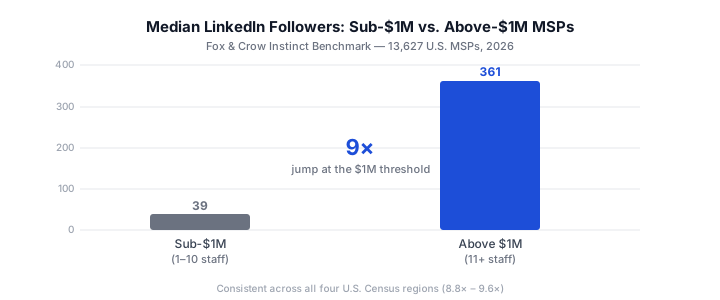 LinkedIn followers by MSP staff band — Fox & Crow Instinct 2026
 LinkedIn follower comparison between sub-$1M and above-$1M MSPs
The Fox & Crow Instinct benchmark of 13,627 U.S. MSPs identifies a visibility gap. The median LinkedIn following for a sub-$1M MSP is 39 followers, compared with 361 for an MSP above $1M — a roughly ninefold difference across the dataset's regions. Website depth shows a similar pattern: sub-$1M MSPs average 45 indexed pages versus 74 for larger firms. The figures reflect correlation, not causation — LinkedIn followers do not create revenue on their own. Still, the pattern suggests that firms above $1M tend to have a more discoverable market presence. A full breakdown of the visibility data is available in the Fox & Crow Instinct MSP growth report.
Want to see where your MSP stands against local competitors?
Fox & Crow Instinct benchmarks MSPs against the signals that showed up in the data: visibility, tenure, tooling, hiring, target-market posture, vertical focus, and regional competition.
FAQ
Why does MSP visibility matter if I'm getting referrals?
MSP visibility matters even when referrals are working because referrals can be unpredictable. When a referred prospect receives your name, they may validate you by searching your MSP, checking LinkedIn, or reading reviews. A strong visibility footprint can help a referral find confirmation rather than silence.
How does MSP LinkedIn strategy differ from generic social media marketing?
MSP LinkedIn strategy differs from generic social media marketing because LinkedIn puts your MSP's name in front of business decision-makers during active business thinking, not passive entertainment scrolling. A post about a common IT mistake your MSP has seen reaches the exact buyer who will face that mistake, in the mindset where they're most likely to act on it. Generic social media reaches a broader audience with weaker purchase intent.
What does a weak MSP digital footprint cost my MSP business?
A weak MSP digital footprint costs your MSP business in two places you probably can't measure directly: deals you were never considered for because the buyer found a competitor who showed up in search, and cold outreach conversations that died when the prospect googled you and found nothing. Both losses are invisible — you don't get a rejection, you just don't get a call. That's what makes the cost easy to underestimate and easy to ignore until the pipeline gets painful.
How long does it take for MSP visibility investment to show results?
MSP visibility investment can take twelve to eighteen months of consistent effort to produce measurable pipeline improvement. That timeline is a reason to begin before results are urgent. Build the footprint before you need it.
Can a small MSP with one or two employees build meaningful MSP market visibility?
A small MSP with one or two employees can build meaningful market visibility, and a founder's direct experience can be an advantage. A founder posting in their own voice about real problems may feel more credible than polished corporate content. Consistent individual posting can build visibility over time, even when a larger team publishes only sporadically.