
Big MSPs Are Always Hiring: What Your Job Postings Say About Your Growth Ceiling
Originally published

Listen to this article
Browser text-to-speech
Methodology note: Fox & Crow Instinct analyzed publicly observable signals from 13,627 U.S. MSPs in 2026. Staff bands are used as a revenue proxy: 1–10 staff ≈ sub-$1M; 11+ staff ≈ above $1M.
Table of Contents
- Why MSP Hiring Is Never Invisible
- What Your Job Posting Communicates
- MSP Hiring Strategy and Your Go-to-Market Signal
- Becoming an Employer of Choice in Your Market
- Making Your MSP Growth Signals Work for You
- What the Data Tells Us
- FAQ
Your MSP's hiring activity is publicly visible.
If you have an open Indeed listing, prospects can find it. If you have a LinkedIn jobs tab with a posting, prospects can see it. If you have a Glassdoor employer page, prospective clients — and prospective employees — can check your reviews, your photos, your response rate.
Most MSP founders think about hiring as an internal activity. It isn't. Every hiring signal your MSP puts out is a piece of market positioning, whether you intended it that way or not.
This post covers what your MSP's hiring signals communicate to the outside world, how to read those signals strategically, and how growth-stage MSPs use their hiring presence as a deliberate go-to-market tool.
Why MSP Hiring Is Never Invisible
When a business owner evaluates an MSP, they're making a multi-year commitment. They want to know that the MSP they sign with today will still be operating, staffed, and growing three years from now.
Hiring is one of the signals they use — often unconsciously — to make that call.
An MSP with an active job posting communicates that it has work to fill. That it's adding capacity. That its current pipeline and client base demand more people. Those are the signals of a company that's not in contraction.
An MSP with no visible hiring presence, no employer page, no reviews, communicates something else. Not necessarily something bad. But the absence of signal leaves the prospect to fill in the blank themselves. Sometimes they fill it with "stable and focused." More often they fill it with "small and stalled."
You don't get to control what a prospect infers from your absence. You only get to control what you put out there.
"The fastest way to fail a hiring screen you didn't know you were in is to have no employer presence at all. Prospects don't just check your website. They check LinkedIn, Indeed, Glassdoor, and your team's profiles. If nothing exists, the story they write for you isn't usually a flattering one."
 Quote: Ian Richardson on MSP hiring signals and employer brand
What Your Job Posting Communicates
Let's be specific about what a job posting signals — and what it doesn't.
An active job posting signals:
- Your MSP is growing or maintaining capacity rather than contracting
- You have budget approval for a hire, which implies a business case exists
- You have an HR process, even a minimal one
- You're visible to technical candidates, which is a talent quality signal in markets where good technicians research potential employers
A job posting does not signal:
- That you know how to hire correctly
- That you'll find the right candidate
- That your culture is strong enough to retain whoever you find
The signal is about trajectory, not execution. And trajectory is what early-stage evaluators use to shortlist MSPs.
For the prospects who are evaluating two or three MSPs, the one with an active hiring presence often reads as more stable — even if the hire never closes and the posting runs for six months with no result.
This is also why letting a job listing go stale matters. A posting from 14 months ago with no update says something different than a current one. It says you either stopped growing or stopped trying. Neither reads well in a competitive evaluation.
 Social graphic about the signals conveyed by an MSP job posting
MSP Hiring Strategy and Your Go-to-Market Signal
The connection between MSP hiring strategy and go-to-market positioning is underappreciated.
Consider what happens when you build a genuine employer brand:
Your MSP has a Glassdoor page with two or three reviews from current employees. The reviews mention that the team works on diverse projects, that leadership communicates well, and that the clients are good. A prospect who checks Glassdoor during their evaluation now has corroborating evidence that your MSP is a real, functional organization — not just a founder with a website.
Your MSP has a LinkedIn company page where you occasionally post about team wins, certifications, or community involvement. A prospect who checks your LinkedIn page now has a sense of who the team is, what they value, and whether this MSP feels like a company that takes its work seriously.
Your MSP has a clean Indeed employer profile with a response rate and a handful of job descriptions that reflect what the business actually does. A prospect who checks Indeed now knows that you're building something.
None of those pieces of content was written for prospects. But all of them are being read by prospects.
The MSP hiring strategy and the go-to-market strategy are not separate functions. They're two outputs of the same positioning decisions.
 Social graphic connecting employer brand to MSP go-to-market positioning
Becoming an Employer of Choice in Your Market
You don't need a hundred employees to be an employer of choice in your local market.
What you need is intentional presence.
The MSPs that candidates want to work for — and that prospects read as stable and growing — have a few things in common:
They have a stated culture. Not a generic "work hard, play hard" statement. A description of what the team actually does, what kind of clients they serve, and what technicians can expect to learn and do in the role. That specificity communicates authenticity.
They have a documented onboarding process. Candidates ask about this in interviews. When MSPs can describe a structured first 90 days — including how a new technician learns the client base, how tickets are assigned, and who they can go to for help — they close better candidates. The documentation signals that the organization is run well enough to absorb a new person.
They respond to applications. This sounds basic. It's not universal. MSPs that don't acknowledge applications have a reputation among technical candidates. That reputation gets shared in community Slack groups, Discord servers, and at local IT meetups. It's small, but it matters in tight talent markets.
They pay fairly and say so. Hiding compensation in job postings is a filtering problem. The candidates who apply without knowing the salary range are a lower-quality pool than the ones who knew and applied anyway. Listing a range improves fit and shortens the hiring cycle.
None of this is expensive. It's time and intention. Both are available to sub-$1M MSPs as well as large ones.
 Social graphic outlining employer-of-choice practices for MSPs
Making Your MSP Growth Signals Work for You
If your MSP is past $2M in MRR and you want the market to see you as a growing firm, audit your employer presence the way you'd audit your website.
Glassdoor: Does a page exist? Are there any reviews? Have you responded to them? Two or three authentic reviews are better than zero, even if they're not all five stars. Prospects know that a business with only five-star reviews has been gaming the platform.
Indeed: Is your employer profile claimed and current? Does your company description reflect what you actually do and who you serve? Are any open job listings refreshed, or are they stale?
LinkedIn company page: Do you have a page? Is it complete — logo, description, industry, size, location? Has anything been posted in the last 90 days? Is your team linked to the company page so their profiles show up under "People"?
Your own careers page: Do you have one? It doesn't need to be elaborate. It needs to exist, to describe your culture honestly, and to make it easy to apply.
If the answer to most of those is "no" or "I'm not sure," you have a go-to-market gap you didn't know about. Fix it before you spend money on outbound.
What the Data Tells Us
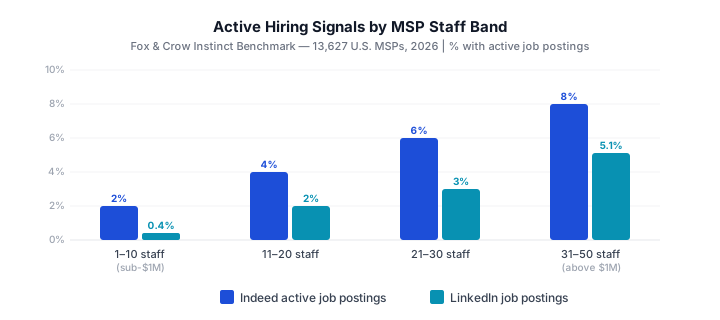 Active hiring signals by MSP staff band — Fox & Crow Instinct 2026
 Active LinkedIn job postings appear at 0.4% of sub-$1M MSPs compared with 5.1% of large MSPs
The Fox & Crow Instinct benchmark of 13,627 U.S. MSPs found that active hiring is a notable behavioral difference between MSPs that have crossed the $1M threshold and those that have not. Just 2% of sub-$1M MSPs show active job postings on Indeed. For the 31–50 staff band, that figure is 8%. LinkedIn job postings show a sharper contrast: 0.4% of sub-$1M firms versus 5.1% of the largest in-scope band. Glassdoor employer pages exist for 24% of sub-$1M shops and 46% of the 31–50 staff band. These are directional correlations, not causal claims. MSPs that look like they are building outward are, in aggregate, more likely to have already crossed the threshold. A full breakdown of hiring signal data by band is in the Fox & Crow Instinct MSP growth report.
Want to see where your MSP stands against local competitors?
Fox & Crow Instinct benchmarks MSPs against the signals that showed up in the data: visibility, tenure, tooling, hiring, target-market posture, vertical focus, and regional competition.
FAQ
How does MSP hiring activity affect the sales process?
MSP hiring activity affects the sales process by shaping the pre-call research a prospect does before agreeing to a meeting. Buyers evaluating managed services providers often check employer platforms as a proxy for company stability and culture. An active hiring presence signals that the business has work to fill and the budget to do it. An absent hiring presence signals nothing — and in a competitive evaluation, silence tends to disadvantage the MSP that is quietest.
What should a small MSP's Glassdoor page include?
A small MSP's Glassdoor employer page should include a current company description, your logo, your location, your industry, and ideally two or three honest reviews. Responding to reviews — even critical ones — signals engagement and transparency. MSPs that ignore negative reviews or have no reviews at all leave a gap that candidates and prospects fill with assumptions. Even a small, genuine presence outperforms absence.
Can job postings help with lead generation for an MSP?
Job postings can contribute to lead generation for an MSP indirectly. When a business owner searches for managed IT support in your area and your MSP appears in employer search results — because you have an active Indeed or LinkedIn presence — it creates another touchpoint. The buyer wasn't looking for a vendor. But they found you anyway. That kind of organic visibility compounds over time without additional spend.
What is the right MSP hiring cadence for a $2M shop?
There is no universal cadence, but a $2M MSP with a healthy pipeline should typically have at least one open role listed at any given time — whether a technician, a vCIO, or an account manager role. If your MSP is genuinely at capacity and has no open roles, consider keeping a general interest form live so that strong candidates can reach you before a formal need opens. The goal is consistent visibility, not necessarily constant headcount growth.
What makes a job posting credible for an MSP?
A credible MSP job posting includes a realistic description of day-to-day responsibilities, a salary range or band, a clear description of the team and client base, and some indication of what growth looks like in the role. Generic postings that describe "dynamic environments" and "cutting-edge technology" without specifics may be less compelling to strong candidates. Specificity can differentiate your listing for candidates and for prospects who read job listings as part of their vendor evaluation.