
There Are No Overnight MSP Success Stories: What Time-in-Market Really Signals
Originally published

Listen to this article
Browser text-to-speech
Methodology: Fox & Crow Instinct analyzed publicly observable web, social, review, hiring, DNS, census, and technology signals for 13,627 U.S. MSPs in 2026. Revenue bands are staff-based proxies: 1–10 staff ≈ sub-$1M; 11+ staff ≈ above $1M. Unless noted, statistics refer to this dataset.
Table of Contents
- The MSP Growth Timeline Most Founders Are Working From Is Wrong
- What Time-in-Market Signals to a Prospect
- Why Compounding Doesn't Show Up When You Expect It
- MSP Maturity Isn't About Size
- How to Use the Time You Have
- What the Data Tells Us
- FAQ
If you've been running your MSP for three years and it still feels hard, that's not a warning sign.
That's the job.
The MSPs you see at the top of their market didn't get there because they found a better stack or hired a better salesperson in year two. They got there because they stayed in the game long enough for the market to recognize them. Time-in-market isn't a consolation prize for MSPs that haven't figured it out yet. It's one of the few things in this business that money can't shortcut.
Here's the direct answer to the question this post is built around: MSP business growth takes longer than most founders expect, and that gap between expectation and reality is the single most common reason MSPs stop building before the compounding starts. The MSP growth timeline most founders are working from is simply wrong. Understanding what time-in-market signals, and why MSP maturity is earned rather than bought, is the difference between pushing through and walking away.
The MSP Growth Timeline Most Founders Are Working From Is Wrong
When I talk to MSP owners who are frustrated with their growth, the first thing I try to understand is what timeline they had in mind when they started.
Most had one.
It usually involves something like: sign a few anchor clients in year one, build MRR to a stable base in year two, start scaling in year three. Clean. Logical. Wrong.
The managed services sales cycle is long by design. You're asking a business owner to hand over one of the most operationally sensitive parts of their company to a firm they've never worked with before. The average prospect already has an IT provider. They're not switching on your schedule. They're switching when their current provider drops the ball and you happen to be the most familiar name in their head at that exact moment.
That familiarity takes time to build. It doesn't come from one cold call or one great proposal.
I cover the go-to-market mechanics behind this in depth in my guide to the MSP growth ceiling, but the short version is this: MSP growth stalls when founders mistake activity for traction and stop building before the market has had enough time to respond.
"The MSPs that look like overnight successes are the ones who kept building the pipeline during the years nobody was watching. Time-in-market isn't a vanity metric. It's the only proof a prospect has that you'll still be around when something goes wrong."
 Quote: Ian Richardson on MSP time in market
What Time-in-Market Signals to a Prospect
A prospect Googles your MSP. Your website says you've been in business since 2019.
That date is doing more work than you think.
For a business owner who is about to hand over their IT infrastructure, that founding year is a credibility signal they use before they ever read your service list. It tells them you survived something. That you figured out how to keep clients. That you've probably seen a ransomware event, a failed migration, a client who wanted out mid-contract. That you're still here.
MSP maturity signals trust in ways that marketing copy can't manufacture. You can write "experienced team" on your website all day. The prospect who's been burned by a two-year-old MSP that folded mid-contract isn't reading that line the same way they're reading your founding date.
Time-in-market also signals something internal. MSPs that have been operating for five or more years have usually built some version of a documented sales process, even if it's informal. They know what their close rate looks like. They know which verticals convert well and which ones drain the pipeline. They've fired at least one client. That institutional knowledge doesn't exist at year two, no matter how talented the founder is.
 MSP growth timeline illustration showing the value of time in market
Why Compounding Doesn't Show Up When You Expect It
Here's what nobody tells MSP founders at the start: the inputs you put in during year one don't pay off in year one.
They pay off in year three.
Sometimes year four.
The outbound motion you run in January generates a conversation in March, a proposal in September, a signed agreement the following spring, and a referral eighteen months after that. The managed services sales cycle doesn't compress because you worked harder. It compresses, slowly, as your pipeline fills with prospects at different stages simultaneously and your reputation starts doing some of the early work for you.
MSPs that hit a growth ceiling often did so because they stopped building the pipeline before that compounding kicked in. They ran outbound for six months, didn't see new logos close, and concluded outbound doesn't work for their MSP. What they experienced wasn't failure. It was the lag.
The MSPs that broke through their growth ceiling kept building during the lag. They treated the pipeline like infrastructure: something you fund consistently, not something you turn on when revenue dips.
The lag is not a signal to stop. It's a signal that the inputs are working.
 MSP pipeline illustration showing delayed growth compounding
MSP Maturity Isn't About Size
I want to be careful here, because this is a point that gets misread.
Time-in-market doesn't automatically produce a mature MSP. I've worked with MSPs that have been operating for over a decade and are still running on tribal knowledge, handshake agreements, and a sales process that lives entirely inside the founder's head.
MSP maturity is about what you build during that time.
A mature MSP has a documented ICP (ideal client profile). It has closed-lost data that tells the story of which deals they shouldn't have chased. It has a QBR process that clients expect and value. It has MRR that's sticky because the relationships are sticky, not just because the contracts are long.
Time-in-market gives you the runway to build those things. It doesn't build them for you.
The MSPs that use their first three to five years to build repeatable systems, even imperfect ones, are the ones that look like overnight successes to everyone who shows up later.
 MSP maturity illustration showing repeatable business systems
How to Use the Time You Have
If your MSP is in the early years and growth feels slow, the question isn't "how do I speed this up." The question is "am I building the right things while I wait."
Here's where to focus:
Document what's working. If you're closing deals, write down why. What was the trigger event for that prospect? What did you say that landed? Tribal knowledge that lives in your head can't be replicated or trained on.
Build your pipeline like it has a twelve-month lag. The appointments you set this quarter are funding deals that close next year. Fund the front of the funnel accordingly.
Collect your closed-lost data. Every deal you didn't win is a data point. Price objections, timing objections, competitor losses — all of it tells you something about your MSP positioning that you can act on.
Let the referral network build slowly and deliberately. Ask for referrals at the right moment in the client relationship, not as a checkbox. One client who genuinely advocates for your MSP is worth more than any outbound list.
Track MRR trends, not just total MRR. Are you adding new logos or just growing existing accounts? Both matter, but they tell different stories about your MSP's growth health.
The MSPs that come out of year five with real traction aren't the ones who found a shortcut. They're the ones who treated the early years as infrastructure investment, not a waiting room.
What the Data Tells Us
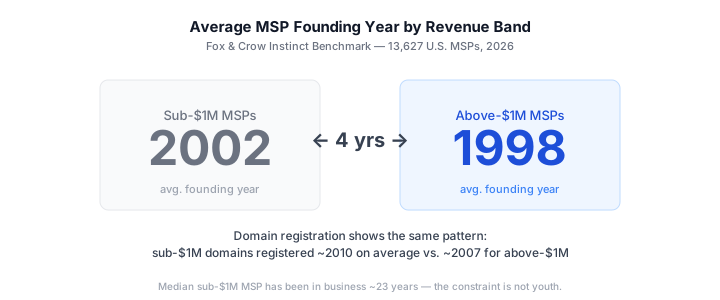 MSP founding year by staff band — Fox & Crow Instinct 2026
 Four-year average founding-year gap between sub-$1M and above-$1M MSPs
The Fox & Crow Instinct benchmark of 13,627 U.S. MSPs shows that time-in-market is one of the most consistent signals separating sub-$1M firms from those above it. Sub-$1M MSPs were founded, on average, in 2002. MSPs above $1M were founded, on average, in 1998 — a four-year gap that holds across all regions. Domain registration tells a parallel story: sub-$1M MSP domains registered around 2010 on average; above-$1M domains registered around 2007. The median sub-$1M MSP has been in business for approximately 23 years, which means the constraint is not youth — it is what firms do with their time in market. These figures reflect correlation, not causation. Time is a necessary condition for the trust-building that managed services sales requires. It is not, on its own, sufficient. A full breakdown of how maturity signals correlate with MSP growth is available in the Fox & Crow Instinct MSP growth report.
Want to see where your MSP stands against local competitors?
Fox & Crow Instinct benchmarks MSPs against the signals that showed up in the data: visibility, tenure, tooling, hiring, target-market posture, vertical focus, and regional competition.
FAQ
How long does it take to grow an MSP to a stable MRR base?
Growing an MSP to a stable MRR base typically takes three to five years, and that range assumes consistent pipeline activity throughout. MSPs that run outbound sporadically, or stop building during slow revenue periods, often reset the clock on their own growth. The displacement sales cycle in managed services is long. Prospects switch providers on their timeline, not yours. Stability comes when your pipeline is full enough at every stage that new logos are closing on a predictable cadence rather than in occasional bursts.
Why does MSP business growth feel slower than expected in years one and two?
MSP business growth feels slower in years one and two because the outputs of your early pipeline work are almost entirely invisible at that stage. The outbound motion, the referral relationships, the brand recognition you're building — none of that converts on a short timeline. MSPs that survive this phase without abandoning their growth activity are the ones that understand the lag is structural, not a sign that the strategy is broken. Year one and year two are the infrastructure years. The revenue follows.
What does MSP maturity look like from the outside?
MSP maturity from the outside looks like a firm with a clear niche, a founding date that signals survival, and a reputation that precedes the sales conversation. Prospects who've been burned by younger or less stable MSPs will use your time-in-market as a filter before they ever read your proposal. A mature MSP also has clients who stay, which means low churn and strong QBR participation. Those signals compound over time in ways that newer MSPs can't manufacture.
Can an MSP accelerate its growth timeline with more marketing spend?
An MSP can accelerate parts of its growth timeline with more marketing spend, but spend can't compress the trust-building cycle at the core of the managed services sale. You can get more conversations faster with a higher outbound budget. You can get better name recognition faster with consistent content. What you can't buy is the prospect's confidence that your MSP will still be operating in three years when their contract is up for renewal. That confidence comes from time-in-market and from the relationships you've built during it.
What's the biggest mistake MSPs make during a slow growth period?
The biggest mistake MSPs make during a slow growth period is cutting the pipeline activity that would have produced results six to twelve months later. MSPs that pull back on outbound, pause marketing, or stop attending industry events when revenue is flat are starving the future version of their business. Slow periods are almost always a pipeline problem, not a product problem. The MSPs that protect their growth inputs during a slow period are the ones that come out the other side with momentum instead of starting over.