
The MSP Growth Ceiling: Why Managed Service Providers Flatline, and Why It Is a Go-to-Market Problem, Not a Service Problem

Listen to this article
Browser text-to-speech
Methodology: This Fox & Crow Instinct analysis covers 13,627 U.S. MSPs in 2026 using publicly observable web, social, review, hiring, DNS, census, and technology-detection signals. Staff bands are used as a revenue proxy: 1–10 staff approximates sub-$1M, while 11 or more staff approximates above $1M. Statistics refer to this dataset unless noted otherwise.
Table of Contents
- Why MSPs Flatline
- The Growth Ceiling Is Usually Misdiagnosed
- How Fox & Crow Instinct Reached This Finding
- What Fox & Crow Instinct Found
- Visibility Is the Brightest Line
- More Services Will Not Fix a Flatlined MSP
- Maturity Matters, But Waiting Is Not a Strategy
- Growing MSPs Stop Selling to Everyone
- Your Vertical Can Be a Launchpad or a Ceiling
- Systems Reveal Whether Growth Is Repeatable
- Hiring Visibility Signals Momentum
- Loud-but-Small MSPs Show What the Market Notices First
- Trust Signals Are Part of the Sale Before the Sales Call
- Geography Shapes Strategy, But It Does Not Excuse Invisibility
- Marketing Muscle Is a Habit, Not a Campaign
- Competition and Opportunity Are Not the Same Map
- How This Presents in a Flatlined MSP
- What to Benchmark Before Hiring Sales or Marketing Help
- What to Do About It
- FAQ
Why MSPs Flatline
MSPs usually flatline because their go-to-market maturity does not keep pace with their service delivery maturity. The provider becomes good enough to retain clients, but not visible enough, focused enough, or systematic enough to create predictable new demand. The growth ceiling is usually not a service-menu problem. It is a market presence, positioning, pipeline, and trust problem.
That is not the answer most MSP owners want, because it is not the easiest problem to fix.
It is much more comfortable to believe growth has stalled because the company needs another service line, another vendor partnership, another security bundle, another salesperson, another website, or another campaign. Those things may matter, but they are rarely the root of the ceiling.
The harder truth is that many MSPs have built a real service business without building a market-facing business alongside it. They can deliver the work. They can keep clients. They can solve technical problems. They can respond when something breaks. But they have not built the external system that makes the right buyers aware of them, helps those buyers understand what they stand for, and keeps the firm present long before a buying window opens.
That is the MSP growth ceiling.
It is the point where the company is too established to be dismissed as a small shop, but not mature enough in its go-to-market motion to keep growing predictably. It has clients, staff, systems, vendors, and a reputation inside its current circle. What it does not have is enough consistent market presence outside that circle.
For MSPs over $3M that are still founder-led in sales, this is where growth often gets frustrating. The business is not new. The founder has already proven the market exists. The team is not sitting idle. Clients are being served. Work is getting done. The company may even be profitable.
And still, the revenue line looks too familiar year after year.
The Growth Ceiling Is Usually Misdiagnosed
Flat growth rarely announces itself as one obvious problem.
It shows up in pieces.
A good quarter comes from project work, but recurring revenue does not move much. A client churns and wipes out the gain from a recent win. The founder gets serious about sales for six weeks, then disappears back into operations. Marketing starts, stops, restarts, and stops again. A salesperson is hired before the company has a clear enough market, message, or follow-up system for that person to inherit. Referrals still happen, but not often enough to build a plan around.
Inside the business, all of this can feel like a sales problem. Or a marketing problem. Or a capacity problem. Or a pricing problem. Or a geography problem. Or a "we need to specialize" problem.
Sometimes one of those is true. More often, they are symptoms of a deeper issue: the MSP has not become legible enough to the market it wants to win.
Legibility matters. A legible MSP is easy for the right buyer to understand. The market can tell who the firm serves, what kind of problem it is best at solving, what proof supports the claim, and why it should be on the shortlist when a trigger event happens.
An illegible MSP may still be good. It may even be better than the visible competitor. But from the outside, it blends in.
The website sounds like every other provider. The LinkedIn page is quiet. The founder has expertise but no public point of view. The company says it serves "small and mid-sized businesses" but cannot name the customer pattern that creates its best margins. The service menu is long, but the market position is thin. The team is busy, but the market cannot see much evidence of momentum.
This is why MSP growth strategy has to start with diagnosis, not tactics. If the constraint is visibility, adding services will not fix it. If the constraint is positioning, a new campaign will only spread the confusion faster. If the constraint is revenue operations, hiring sales without a system can create activity without accountability. If the constraint is market trust, a better pitch will not overcome weak public signals.
The MSP growth ceiling is rarely one missing tactic. It is usually a maturity gap.
How Fox & Crow Instinct Reached This Finding
Fox & Crow Instinct is Fox & Crow Group's MSP decision intelligence platform. It analyzes public market signals across visibility, positioning, service posture, tooling, hiring activity, reviews, security posture, geography, and market density to identify what separates stalled MSPs from visible, growing firms.
For this study, Fox & Crow Instinct analyzed 13,627 North American MSPs across public signals, including estimated staff band, LinkedIn presence, website depth, target-market posture, PSA and CRM signals, hiring visibility, reviews, DNS and email security posture, geography, and market density.
The study uses staff band as a revenue-stage proxy. In broad terms, 1–10 staff maps to the sub-$1M range, while 11 or more staff serves as a proxy for firms that have crossed the approximate $1M line. That proxy is not a claim of reported revenue. It is a market benchmark model designed to compare public signals at scale.
The findings should be read as signals, not guarantees. LinkedIn followers do not cause growth. A PSA does not cause growth. A vertical does not guarantee growth. Geography does not decide the future of the business. What the data shows is which signals are associated with larger, more visible, more mature MSPs.
For an MSP owner, that is the point. The data is not a formula. It is a way to see where the business may be underdeveloped compared with the firms it wants to become.
What Fox & Crow Instinct Found
Fox & Crow Instinct found that the firms moving past the growth ceiling are not simply broader service providers. They are more visible, more mature, more specific about who they serve, more operationally legible, and more consistent in how they show up.
The clearest public signal was visibility. Median LinkedIn followers rose sharply across staff bands, from 39 in the 1–10 staff band to 271 in the 11–20 staff band. That jump appears around the approximate $1M transition. The gap widens again in larger bands, with the 31–50 staff group showing a median of 860 followers.
That does not mean social media is the strategy. It means visibility leaves evidence behind. Bigger MSPs tend to have more public surface area. More people have encountered them, followed them, referred them, worked around them, noticed their hiring, or seen their point of view.
At the same time, service breadth did not separate larger MSPs from smaller ones in the way many owners might expect. Average managed services offered stayed nearly flat across the bands. Security offerings and monitoring services were also broadly flat. The larger firms were not obviously larger because they had dramatically longer menus.
Maturity showed up too. Larger MSPs tended to be older, and their domains tended to be older. But time alone did not explain growth. Plenty of mature MSPs remain quiet in the market. Years in business only become a growth asset when the firm turns that experience into visible proof.
Target-market posture also changed with size. Smaller MSPs were more likely to present as broad SMB generalists. Larger MSPs were more likely to show enterprise, mid-market, or vertical posture. That matters because many MSPs over $3M have already outgrown the market story they still tell. Their best clients may be larger, more complex, or more specialized than the company's public positioning suggests.
Vertical strategy mattered, but not all niches performed the same way. Federal, government, telecom, technology, and software-development-oriented MSPs showed stronger scale signals than the all-MSP baseline. The lesson is not to chase someone else's vertical. It is to understand whether the niche has enough urgency, budget, complexity, density, and proof potential to carry the next stage of growth.
Operational signals mattered as well. PSA and CRM indicators were more revealing than generic security-tool signals. That does not mean a specific platform creates growth. It means growing MSPs are more likely to show signs of operational and revenue-operations maturity. They are less dependent on founder memory, informal follow-up, and heroic effort.
The same pattern appeared in hiring visibility, trust signals, geography, content cadence, and market density. Growing MSPs become easier for the market to read. They look active. They look specific. They look current. They look like companies building toward something.
That is the through-line of the study: the MSP growth ceiling is not a single failure. It is the accumulated effect of weak visibility, unclear positioning, inconsistent market activity, underdeveloped revenue operations, and public trust signals that do not fully support the story the MSP wants buyers to believe.
Visibility Is the Brightest Line
The first mistake is treating visibility like vanity.
A lot of MSP owners hear "LinkedIn followers" or "market presence" and immediately put it in the soft category. They see it as branding, not business development. They know referrals matter. They know relationships matter. They know client service matters. But public visibility can feel optional, especially for technical founders who built the business through trust, delivery, and direct relationships.
The data suggests otherwise.
Visibility is not the same thing as popularity. It is not about being loud for the sake of being loud. For an MSP, visibility is the market's ability to recognize, remember, and validate the firm before a buying decision is active.
That last part matters. Most buyers do not wake up one morning and conduct a perfectly neutral search for the best MSP. They move because something happens. Their current provider misses the mark one too many times. A cyber insurance renewal exposes gaps. A leadership change creates scrutiny. A bad audit raises questions. A ransomware story in their peer group makes the board nervous. Growth creates complexity the current IT model cannot handle.
By the time that trigger happens, the visible MSP has an advantage. The buyer has already seen the company. A peer has mentioned it. A founder post made a point that stuck. A job posting made the company look like it was growing. A case study sounded relevant. A search result confirmed the company was active in the right market.
The invisible MSP may still be capable. It may even be better. But it is asking to be discovered at the exact moment the buyer is trying to reduce risk.
That is a hard way to win.
 Carrie Richardson quote about the market-facing systems behind MSP growth
| Signal | Sub-$1M | Above $1M |
|---|---|---|
| Median LinkedIn followers | 39 | 361 |
| Website pages indexed | 45 | 74 |
| LinkedIn maturity score (0–1) | 0.030 | 0.114 |
| Actively posting (last 4 months) | 17% | 40–59% |
 Study of 13,627 U.S. MSPs highlighting go-to-market signals associated with growth
Want to see where your MSP stands against local competitors?
Fox & Crow Instinct benchmarks MSPs against the signals that showed up in the data: visibility, tenure, tooling, hiring, target-market posture, vertical focus, and regional competition.
For flatlined MSPs, the visibility problem is often hidden by operational busyness. Inside the company, everything feels active. Tickets are moving. Engineers are busy. Clients are calling. Vendors are emailing. Projects are being scoped. The founder is constantly in motion.
The market does not see that. The market sees whatever escapes the building.
A deeper breakdown of this finding is covered in MSP Visibility Is Not Vanity and Loud-but-Small MSPs.
More Services Will Not Fix a Flatlined MSP
When growth stalls, adding services feels productive.
It gives the owner something to build. It gives the team something to package. It creates a reason to update the website. It may even create a short-term burst of internal energy. The company can say it now offers co-managed IT, compliance, vCISO, security awareness training, Microsoft licensing, backup audits, or a new cybersecurity bundle.
The problem is that more services do not necessarily make the MSP easier to buy from.
If the market already struggles to understand the firm's value, a longer menu can make that worse. The buyer is not usually sitting there thinking, "I would choose this MSP if only it had one more line item." More often, the buyer is trying to answer more basic questions. Do they understand my business? Have they solved this problem before? Can I trust them? Are they stable?
The Fox & Crow Instinct data is useful here because it pushes against a common assumption. Average managed services offered stayed nearly flat across staff bands. Security offerings and monitoring were also broadly flat. The firms above the growth line were not simply running away from smaller MSPs by adding more services.
A service menu is not a market position. A stack is not a strategy. A bundle is not a reason to believe.
For more on this specific growth myth, read More Services Will Not Fix a Flatlined MSP.
 Illustration supporting the service-breadth finding for flatlined MSPs
Maturity Matters, But Waiting Is Not a Strategy
The MSP market rewards time, but it does not reward waiting.
Fox & Crow Instinct found that larger MSPs tend to be older. Median company age rose from 23 years in the 1–10 staff band to 28 years in the 31–50 staff band. Domain age followed a similar pattern. That is not surprising in a high-trust category. Businesses are cautious about who they allow into their technology environment. They want to know the provider will be around, responsive, stable, and capable.
Time in market helps create that belief. But many mature MSPs do not turn it into market proof. They have the history, but the market cannot see what the history means. The website does not reflect it. The content does not teach from it. The sales process does not use it. The case studies do not show it.
That is how a twenty-year-old MSP can look less compelling than a younger competitor with a sharper point of view.
Age is an asset only when it is converted into trust. Otherwise, it is just a founding date.
For a deeper look at the maturity signal, read There Are No Overnight MSP Success Stories.
 Illustration of MSP maturity as a visible trust signal
Growing MSPs Stop Selling to Everyone
Most MSPs start with a broad market because they have to.
In the early years, revenue matters more than focus. A law firm, a dental practice, a warehouse, a nonprofit, a construction company—if the business needs IT support and can pay, it looks like opportunity.
But broad SMB generalism gets harder as the company grows.
Fox & Crow Instinct found that target-market posture changes with size. SMB focus falls as MSPs move into larger staff bands, while enterprise, mid-market, and vertical posture rise. This does not mean every growing MSP abandons SMB. It means growth is associated with becoming more specific about who the firm is built to serve.
For MSPs over $3M, the problem often gets more subtle. The company may already have a better customer pattern hiding inside the client base. The most profitable clients may be larger, more regulated, more complex, or concentrated in a few industries. But the public message still speaks to everyone.
That mismatch creates drag.
For more on this migration, read The Climb Out of SMB.
Your Vertical Can Be a Launchpad or a Ceiling
Specialization is not automatically a growth strategy.
A niche helps when it gives the MSP leverage—from budget, urgency, compliance pressure, technical complexity, referral density, or a buyer community that talks to itself.
But a niche can also become a trap.
Fox & Crow Instinct found that vertical performance varies meaningfully. Federal and government-oriented MSPs showed much stronger scale signals than the all-MSP baseline (Federal: 73% above the $1M proxy line, vs. 32% for all MSPs). Some popular specialist categories sat much closer to the average. Marketing-agency-focused MSPs showed 9%.
The lesson is not that every MSP should chase the highest-performing vertical. It is that vertical strategy has to be validated, not assumed.
The right niche can break the ceiling. The wrong niche can become the ceiling.
For the vertical strategy finding, read Your MSP Niche Is Either a Ceiling or a Launchpad.
 Illustration of how vertical-market focus can support MSP growth
Systems Reveal Whether Growth Is Repeatable
Operational maturity shows up before a buyer ever sees the inside of the business.
Fox & Crow Instinct found that PSA and CRM signals were more revealing than generic security-tool signals. ConnectWise shops were 48% above the $1M proxy line, compared with 30% for MSPs with no detected PSA. Salesforce (CRM) was about 3x more common in larger MSPs than smaller ones.
The point is not that a specific tool makes an MSP grow. Tools do not create discipline by themselves. The signal matters because it points to something bigger: whether the company is managing the business as a system.
This is where many founder-led MSPs get stuck. The service side has some process because it has to. But the revenue side is often less mature. Lead sources are unclear. Follow-up depends on memory. Pipeline stages are inconsistent. Expansion opportunities live in the founder's head.
A growing MSP needs revenue operations, not just service operations.
For more on this signal, read The PSA Tell.
Hiring Visibility Signals Momentum
Hiring is not only an internal event.
In the MSP market, visible hiring is a public signal. It tells buyers, candidates, vendors, and referral partners that the company is active. It suggests demand. It suggests investment. It suggests the company is building capacity, not just maintaining the status quo.
Fox & Crow Instinct found that active hiring rose across staff bands, from 2% in the 1–10 staff band to 8% in the 31–50 staff band. LinkedIn job postings and Indeed presence showed related signals. Larger MSPs tend to be more visible as employers.
A company that is hiring looks alive. A company that never talks about its team, roles, certifications, or culture can look static, even if it is healthy inside.
For more on hiring as a market signal, read Hiring Out Loud.
Loud-but-Small MSPs Show What the Market Notices First
One of the more interesting findings in the study is the Loud-but-Small cohort.
Fox & Crow Instinct identified 446 sub-$1M MSPs with the visibility profile of larger firms. These MSPs represented roughly 5% of sub-$1M providers. Their median LinkedIn following was 642, compared with 32 for typical sub-$1M MSPs and 361 for actual MSPs above the $1M proxy line.
This group matters because it shows that visibility can lead revenue.
These firms are not pretending to be larger than they are. Most still showed 10 or fewer employees. But they have already built a market presence that looks more mature than their headcount. They are younger on average than actual larger MSPs, more visible than typical peers, and more likely to show enterprise posture.
For established but flatlined MSPs, this should be a warning. A younger, smaller competitor can become more legible to the market before it becomes larger in revenue.
For the full finding, read Loud-but-Small MSPs.
Trust Signals Are Part of the Sale Before the Sales Call
Trust does not start when the first sales meeting begins.
It starts when the buyer searches the company. When they look at LinkedIn. When they read reviews. When they check whether the website feels current.
For security-forward MSPs, that includes technical trust signals.
Fox & Crow Instinct analyzed SPF and DMARC posture across MSP domains. DMARC enforcement moved from 43% in the 1–10 staff band to 53% in the 31–50 staff band. Among MSPs selling security services, DMARC enforcement was 51%. For non-security sellers, it was 37%. About 30% of all MSPs run DMARC in monitor-only mode that blocks nothing.
A security message becomes weaker when visible trust signals do not support it. The market can see more than the MSP may think.
For more on public trust signals and email authentication, read The MSP Trust Gap.
Geography Shapes Strategy, But It Does Not Excuse Invisibility
MSP owners often blame the market.
But geography did not explain the growth ceiling as cleanly as many MSPs might expect.
Fox & Crow Instinct found that the share of MSPs above the $1M proxy line was broadly similar across regions: 32% in the South, 31% in the West, 32% in the Northeast, and 36% in the Midwest. The visibility jump appeared across regions as well. Median followers rose from 41 to 363 in the South, 34 to 327 in the West, 41 to 370 in the Northeast, and 42 to 371 in the Midwest.
That means geography is an input, not a verdict.
Geography should shape the go-to-market motion. It should not become a hiding place for an underbuilt one.
For more on the regional finding, read You Can Build a Growing MSP Almost Anywhere.
Marketing Muscle Is a Habit, Not a Campaign
A lot of MSPs do not have a visibility problem because they never try marketing. They have a visibility problem because they do it in bursts.
Fox & Crow Instinct found that recent LinkedIn posting activity rose with staff band. Only 17% of 1–10 staff MSPs had posted on LinkedIn in the prior roughly 120 days. That rose to 40% in the 11–20 and 21–30 staff bands, and 58% in the 31–50 staff band.
The larger firms were not just more followed. They were more likely to have shown up recently.
Visibility is not a one-time asset. It decays when neglected. The market has a short memory, especially in categories where buying cycles are long and trigger events are unpredictable.
For more on cadence, read MSP Marketing Muscle.
Competition and Opportunity Are Not the Same Map
MSPs often judge opportunity by what they can see.
Fox & Crow Instinct's market density analysis complicates that picture.
MSP density varies widely by state, with a roughly 8x spread. DC showed about 15.8 MSPs per 100,000 residents, while Mississippi showed about 2.0. Delaware, New Hampshire, Wyoming, Maryland, Virginia, New Jersey, and Colorado were also more saturated. Mississippi, Arkansas, Alabama, Kentucky, and South Carolina showed lower density.
Density is not destiny. But it changes the strategic question. A crowded market demands a different posture. A lower-density market may offer white space, but only if there is enough buyer demand to support growth.
For the market-density finding, read The Map of MSP Opportunity Is Not the Map of MSP Competition.
How This Presents in a Flatlined MSP
A flatlined MSP usually does not experience the growth ceiling as a clean strategic problem. It feels more personal and more chaotic than that.
The founder feels like they are always working, but never creating enough forward motion. The service team is busy, but sales feels episodic. The company has loyal clients, but not enough new qualified opportunities. Referrals still come in, but they are unpredictable. Marketing exists, but it is inconsistent. The business has a CRM, but the real pipeline still lives in conversations, memory, and old email threads.
The founder often becomes the glue holding the growth motion together. They know which prospects matter. They know which clients might expand. They know the best stories. They know why the company is different.
But the market does not know unless the founder is in the room.
That is the real ceiling. A company cannot scale a go-to-market motion that only exists when the founder has time to personally explain it.
What to Benchmark Before Hiring Sales or Marketing Help
Before a flatlined MSP hires another salesperson, launches another campaign, or adds another service, it should benchmark the market-facing business with the same seriousness it applies to service delivery.
Start with visibility. Can the right buyers find the MSP? Does the company show up where those buyers look?
Then benchmark positioning. Can the team clearly name the ideal customer? Does the homepage make a choice, or does it try to speak to everyone?
Next, benchmark proof. Which claims are supported by evidence? Are there case studies, examples, reviews, or customer outcomes that make the MSP easier to trust?
Then benchmark revenue operations. Is the CRM clean enough to manage growth? Are lead sources tracked? Are follow-up stages defined?
Benchmark trust signals too. Does the company's public security posture match its message? Are SPF, DKIM, and DMARC handled properly? Are reviews recent?
Finally, benchmark the market itself. How dense is the territory? Which verticals have enough opportunity?
These benchmarks should come before major growth investments.
What to Do About It
The first move is not to do everything.
That is how flatlined MSPs create another burst of activity that fades.
Clarify the Market
The MSP has to decide who it is trying to win next. Not in vague terms. Not "small and mid-sized businesses." The useful answer includes size, complexity, vertical or operating model, buying trigger, budget reality, pain, and reason to choose this firm.
Make the Position Specific
Once the market is clear, the message has to become sharper. The MSP should be able to explain what it knows about that buyer that a generic provider does not.
Turn Experience Into Proof
Most established MSPs have more proof than they use. It is buried in QBRs, tickets, renewal conversations, project histories, client rescues, security findings, and founder memory. That proof needs to become visible.
Build One Consistent Visibility Motion
Do not start with five channels. Start with one motion the company can sustain for a year. The right motion depends on the market. The wrong motion is the one that disappears when the founder gets busy.
Put Revenue Operations Under the Growth Motion
Visibility without follow-up leaks value. The MSP needs a basic revenue-operations backbone: defined stages, clean ownership, source tracking, follow-up cadence, disqualification rules, and weekly review.
Fix Trust Gaps Before Making Bigger Claims
If the MSP wants to be seen as strategic, secure, mature, or enterprise-ready, its public posture has to support that story.
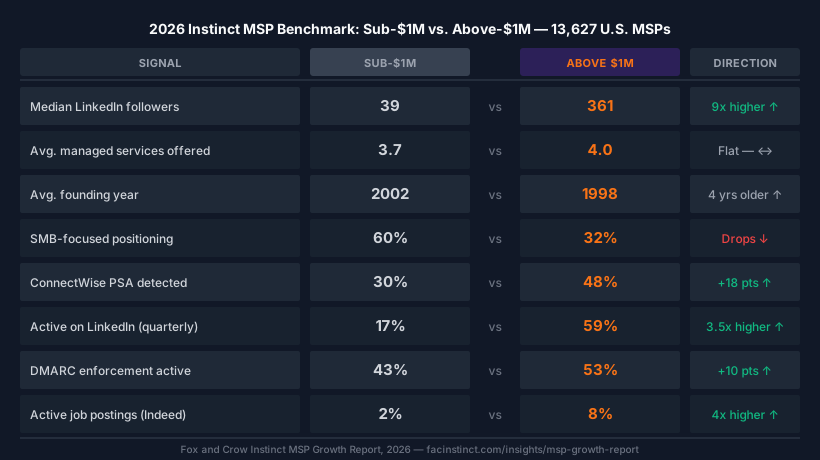 Summary chart of MSP growth signals from the Fox & Crow Instinct benchmark study
Questions MSP Owners Ask
Why do MSPs flatline after $3M?
MSPs often flatline after $3M because the company has outgrown founder-led sales but has not yet built a repeatable go-to-market system. The business may have strong delivery, loyal clients, and technical maturity, but growth remains dependent on referrals, founder relationships, inconsistent marketing, and reactive follow-up.
What separates growing MSPs from stagnant MSPs?
Fox & Crow Instinct data suggests that growing MSPs are more visible, more specific about who they serve, more mature in public market signals, and more operationally disciplined. They are not simply selling more services. They are easier for buyers, referral partners, candidates, and the market to understand.
Is MSP growth driven by adding more services?
Usually not by itself. Fox & Crow Instinct found that average managed services offered stays broadly flat across staff bands. More services may expand revenue inside a strong growth system, but they rarely fix weak visibility, unclear positioning, poor follow-up, or an underdeveloped pipeline.
What should an MSP benchmark before hiring sales or marketing help?
An MSP should benchmark visibility, positioning, proof, CRM hygiene, pipeline accountability, referral motion, trust signals, target-market clarity, and market density before hiring sales or marketing help. Hiring before those pieces are clear often puts pressure on the hire to create a system the business has not defined.
Does LinkedIn really matter for MSP growth?
LinkedIn is not the whole strategy, but it is a visible signal. Fox & Crow Instinct found a sharp LinkedIn follower gap between smaller and larger MSPs, and larger MSPs were more likely to have posted recently. The lesson is not "post for the sake of posting." The lesson is that visible market activity is associated with more mature MSPs.
How does an MSP know whether its niche is helping or limiting growth?
A niche helps when it has enough budget, urgency, complexity, density, and proof potential to carry growth. It limits growth when the market is too small, too price-sensitive, too vague, or too easy for generalists to serve.
Read the Full MSP Growth Ceiling Series
- MSP Visibility Is Not Vanity
- More Services Will Not Fix a Flatlined MSP
- There Are No Overnight MSP Success Stories
- The Climb Out of SMB
- Your MSP Niche Is Either a Ceiling or a Launchpad
- The PSA Tell
- Hiring Out Loud
- Loud-but-Small MSPs
- The MSP Trust Gap
- You Can Build a Growing MSP Almost Anywhere
- MSP Marketing Muscle
- The Map of MSP Opportunity Is Not the Map of MSP Competition
If you are still under $1M, do not start here. Start with the free work: read, post, talk to peers, benchmark yourself, and learn enough to know what you should never outsource.
Fox & Crow is a small boutique firm. You work directly with Carrie Richardson and Ian Richardson—not a junior account team, a generic agency pod, or a vendor playbook.
If your MSP is already past $3M ARR and has flatlined after failed sales hires, outsourced marketing spend, or founder-led growth that no longer scales, talk directly with us.
Book a conversation Or call Carrie Richardson: 517-243-3516