
You Can Build a Growing MSP Almost Anywhere

Listen to this article
Browser text-to-speech
Methodology note. This analysis is based on data from the Fox & Crow Instinct benchmark study, conducted with 13,627 U.S. MSPs in 2026. The dataset includes publicly observable signals from web, social, review, hiring, DNS, census, and technology-detection sources. Revenue bands are proxied from staff using an industry benchmark model: 1–10 staff approximates sub-$1M; 11+ staff approximates above $1M. All statistics cited refer to that dataset unless otherwise noted.
Table of Contents
- What the data says about MSP geography and growth
- Step 1: Assess your MSP local market before you do anything else
- Step 2: Define your MSP regional strategy around a realistic radius
- Step 3: Build a vertical wedge for your MSP local market
- Step 4: Build an outbound motion that fits your market size
- Step 5: Create local market authority before you need it
- Common mistakes in MSP geography growth
- FAQ
I've watched MSP owners in mid-sized Midwestern cities convince themselves they can't grow because they're not in a major metro.
That's a go-to-market problem caused by no research, and held up by a limiting belief.
By the end of this post, you'll know how to assess your local MSP market honestly, build a regional growth strategy that fits your actual footprint, and stop using location as a reason your pipeline is thin.
This connects directly to a broader issue we've written about extensively: the MSP growth ceiling is almost never a service delivery problem. It's a go-to-market problem. Geography is just one of the places that truth hides.
This post is part of Fox & Crow's Q3 2026 MSP Flatline series. The full diagnosis is in The MSP Growth Ceiling.
What the data says about MSP geography and growth
Fox & Crow Instinct found that the share of MSPs above the $1M proxy line was broadly consistent across all four U.S. Census regions: 32% in the South, 31% in the West, 32% in the Northeast, and 36% in the Midwest.
More telling: the LinkedIn follower jump that separates sub-$1M MSPs from larger ones appears in every region at roughly the same multiple.
| Region | Sub-$1M followers | Above $1M followers | Multiple |
|---|---|---|---|
| Midwest | 42 | 371 | 8.8x |
| Northeast | 41 | 370 | 9.0x |
| South | 41 | 363 | 8.9x |
| West | 34 | 327 | 9.6x |
The growth ceiling is not a geography problem. It is a go-to-market problem that looks like a geography problem when the MSP hasn't done the work to diagnose it.
Want to see where your MSP stands against local competitors?
Fox & Crow Instinct benchmarks MSPs against the signals that showed up in the data: visibility, tenure, tooling, hiring, target-market posture, vertical focus, and regional competition.
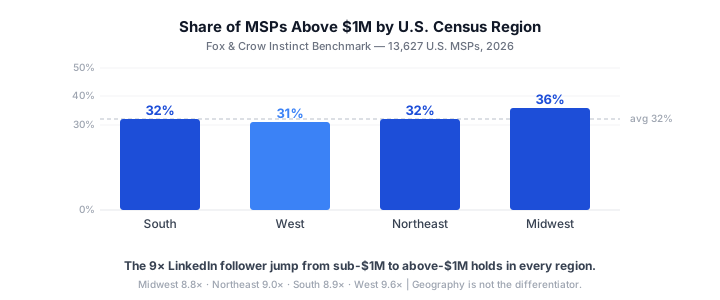 Regional comparison of sub-$1M and above-$1M MSP crossing rates from the 2026 Fox & Crow Instinct benchmark
 MSP crossing rates range from 31% to 36% across U.S. regions while the visibility gap remains consistent
"Geography is almost never the reason an MSP isn't growing. The market is usually there. The MSP just hasn't worked it hard enough to find out."
 Quote: Ian Richardson on MSP geography and market opportunity
Step 1: Assess your MSP local market before you do anything else
Most MSP owners skip this step entirely. They either assume there's no market, or they assume the market is there and start selling without testing the assumption.
Both are wrong.
What a real local market assessment looks like:
Pull your county and regional business license data.
Count businesses with 20 to 150 employees. That's your addressable market in most MSP local markets, not the full business count your chamber of commerce brochure loves to tout.
Then filter by vertical.
If you're in a region with a heavy manufacturing base, count the manufacturers. If healthcare dominates, count the practices. You're not trying to sell to every business. You're trying to find the cluster of businesses where your existing wins are concentrated.
One MSP I worked with in a secondary market was convinced their city was too small. When we pulled the data, they had over 400 businesses in their target size range within a 30-mile radius. They had closed exactly 11 of them.
That's not a small market. That's an untouched market.
What to look for:
- Businesses in the 20–150 seat range
- Verticals where you have at least two existing clients
- Companies with a compliance requirement (healthcare, legal, financial services, manufacturing with government contracts)
- Businesses that have grown in the last three years (growing companies break their IT faster)
Do this before you spend a dollar on outbound.
 Checklist for assessing an MSP's local market by business size, vertical, compliance needs, and recent growth
Step 2: Define your MSP regional strategy around a realistic radius
The mistake here is geography sprawl.
MSPs in secondary markets often compensate for perceived local scarcity by expanding their radius to the point where they're technically competing in markets they have no real presence in.
Your MSP regional strategy should be built around the radius where your physical presence is a genuine differentiator.
The honest radius test:
Ask yourself this. If a prospect two hours away has a server emergency at 9 PM on a Friday, can your team respond on-site in a way that matters? If the answer is no, or not reliably, that prospect is going to find that out eventually.
A tighter radius, worked deeply, beats a sprawling territory worked superficially. Every time.
How to define the right radius for your MSP:
- Start with where your current clients are clustered. That cluster is your home territory.
- Expand only when your home territory is genuinely saturated, not when you're bored or anxious about pipeline.
- In rural or secondary markets, a 60–90 mile radius is often the right working territory. In dense suburban areas, 20–30 miles is frequently enough.
- Factor in drive time, not just miles.
One MSP I worked with in the Southeast contracted their prospecting radius from 150 miles to 45 miles and doubled their close rate inside 18 months. Fewer prospects, better fit, faster trust-building because the MSP was a recognizable name in that smaller market.
Step 3: Build a vertical wedge for your MSP local market
This is where MSP geography growth accelerates.
General positioning in a local market is almost always weaker than vertical positioning. Prospects talk to each other. If you're the MSP that serves dental practices in your region, every dental practice owner who asks their peer for an IT referral gets your name.
If you're just the local IT company, you get whatever referrals happen to wander past.
How to build your vertical wedge:
Start with what you already have. Look at your client list and find the vertical where you have two or more clients. That's your wedge. You don't need five clients to claim a vertical. You need two clients and the willingness to do the case study.
Then execute this sequence:
- Document exactly what you do for those clients in that vertical. What compliance requirements do you manage? What software do you support? What's the specific problem you solve that a generalist MSP probably fumbles?
- Build a simple one-page positioning statement for that vertical. This is the thing your sales team reads before every call into that vertical.
- Use your existing clients in that vertical as referral sources. Ask them directly: who else in your network is complaining about their IT situation right now?
- Build your cold outbound list in that vertical until you have worked the reachable market deeply enough to measure response, conversion, and referral patterns. Then decide whether to expand.
This is the single fastest path to MSP growth by region for companies that feel stuck.
 Four-step sequence for building an MSP vertical market strategy from existing client experience
Step 4: Build an outbound motion that fits your market size
Outbound looks different in a 50,000-person market than it does in a major metro. The mechanics matter.
In smaller and secondary markets, referral velocity can be higher.
Every cold call your team makes in a small market has a reasonable chance of reaching someone who already knows your name, knows a client of yours, or knows someone who does. That's an asset. Use it. Train your callers to ask for referrals on every call, not just after a close.
In mid-size markets, events are disproportionately effective.
Hosting a small breakfast briefing for 15 local business owners on a topic like cyber insurance requirements or AI policy costs very little and positions your MSP as the local authority in a way that no amount of cold calling replicates at that speed.
In larger regional markets, you need more infrastructure.
If your MSP regional strategy includes a city of 500,000 or more, you need dedicated outbound capacity. Whether that's an internal BDR or an outsourced appointment-setting program, trying to do this with the owner making calls between service delivery tasks converts poorly.
Practical outbound checklist for your MSP local market:
- Build a prospect list for your target vertical, target size range, and working radius that is large enough to support a consistent cadence.
- Use list enrichment to get accurate direct dials and decision-maker names before you start calling.
- Set a multi-touch call cadence before you mark a prospect as non-responsive.
- Track everything in your CRM. If it's not in the CRM, it didn't happen.
- Review your pipeline weekly, not monthly.
Step 5: Create local market authority before you need it
This is the step most MSPs skip because it doesn't feel like sales.
It is sales. It's just slower.
Local authority-building tactics that work for MSPs:
- Join the chamber of commerce and go to the meetings. Not to pitch. To be known.
- Sponsor one local business event per quarter. Not an IT event. A general business event where your prospects already gather.
- Contribute to the local business journal. Many regional business publications are actively looking for contributors on technology and cybersecurity topics. A bylined column builds credibility with a local audience that cold outbound can't reach the same way.
- Speak at industry vertical events. If you're targeting manufacturers, speak at the regional manufacturing association meeting.
One MSP in the Midwest spent two years showing up at a regional healthcare industry group before ever pitching a single member. By year three, they had six healthcare clients from that group. The referrals started coming in without asking.
 Local authority-building tactics for MSPs, including events, publications, and industry associations
Common mistakes in MSP geography growth
Treating the market as the constraint before you've worked it.
The number of MSPs that have told me their town is too small, and then haven't cold-called 100 businesses in it, is larger than I'd like to admit. Work the market before you declare it tapped.
Skipping the local presence in favor of remote-only positioning.
Remote management is a feature, not a brand. In secondary and mid-size markets, local presence is still a genuine buying factor.
Expanding before your core market is worked deeply.
Sprawl is not growth. If your home market has 400 target-size businesses and you've closed 15, you have not exhausted the market.
Competing on price because you assume a smaller market means less budget.
Smaller-market businesses pay for quality when the relationship is strong and the fit is clear. Competing on price is a positioning failure, not a market reality.
Building no local reputation and wondering why referrals are slow.
Referral velocity in a local market depends heavily on how well known and trusted you are. Unknown MSPs rarely get referrals.
FAQ
Can an MSP really grow in a small market, or is there a minimum population threshold?
An MSP can grow in a small market as long as there are enough businesses in the target size range within a workable radius. Population isn't the relevant variable. Business density in your target vertical and size range is. An MSP in a town of 40,000 that is surrounded by regional manufacturing and healthcare businesses may have a more accessible market than an MSP in a dense city competing with 50 other providers for the same prospects.
Why isn't my MSP getting referrals even though clients seem happy?
Your MSP isn't getting referrals even though clients seem happy because happy clients don't automatically think of you when someone asks for a recommendation. Satisfied clients are not active promoters unless they've been asked and reminded. Build a referral ask into your QBR process and you'll see that change.
How do MSPs compete with larger national providers in a regional market?
MSPs compete with larger national providers in a regional market by owning the local relationship. National MSPs can't send someone on-site in 45 minutes. They can't show up at the chamber breakfast. They can't be the provider that the regional HR firm has known for six years. Local presence, local reputation, and vertical depth are the three things a national provider structurally can't replicate in a regional market.
What is the right MSP regional strategy for an MSP that has already hit a growth ceiling locally?
The right MSP regional strategy for an MSP that has hit a genuine local ceiling is to expand vertically before expanding geographically. If you've exhausted your home vertical, add an adjacent vertical in your current radius before you start prospecting two hours away. Vertical expansion in a known geography is faster and cheaper than geographic expansion into a new market where you have no reputation and no referral network yet.
How do MSPs know when their local market is saturated versus just under-prospected?
An MSP knows its local market may be saturated when it has systematically contacted most target-size businesses in the working radius and a significant portion are already committed to a managed services provider. Under-prospected markets can feel saturated because the pipeline is thin even though outreach coverage is also thin. If your team has not documented consistent outreach across most of the target list, the outbound motion is incomplete and the saturation claim is premature.