
Your MSP Niche Is Either a Ceiling or a Launchpad: How to Tell Which One You're In
Originally published

Listen to this article
Browser text-to-speech
Methodology note: Fox & Crow Instinct analyzed publicly observable signals from 13,627 U.S. MSPs in 2026. Staff bands are used as a revenue proxy: 1–10 staff ≈ sub-$1M; 11+ staff ≈ above $1M.
Table of Contents
- What a Real MSP Vertical Strategy Looks Like
- When a Niche Becomes a Ceiling
- When a Niche Is a Launchpad
- How to Pick the Right Vertical for Your MSP
- The Mistake MSPs Make When Going Vertical
- What the Data Tells Us
- FAQ
The question MSP founders almost always get wrong about vertical strategy is this: they assume the niche is the variable.
It isn't.
Two MSPs can pick the exact same vertical and get completely different results — one breaks through, one flatlines. The vertical gave one of them a launchpad and the other one a ceiling, and the difference had nothing to do with which vertical they chose. It had to do with what they did inside it.
This post is about how to tell which kind of niche you're in, and what to do about it either way.
What a Real MSP Vertical Strategy Looks Like
A real MSP vertical strategy is not "we focus on healthcare." That's a targeting decision. A vertical strategy is what you build around that target: the language you use, the risks you lead with, the compliance hooks you understand deeply, the peer organizations you're visible in, the case studies that prove you've done it before.
The MSP that wins in healthcare isn't winning because they said the word "HIPAA" in a proposal. They're winning because the prospect felt, in the first conversation, that this MSP understands what a business associate agreement actually means for their operations, what a breach notification timeline looks like under state law, and what kind of audit trail their cyber insurance carrier is going to ask for at renewal.
That's not a stack. That's earned vertical credibility. And it takes time and deliberate investment to build.
A real vertical strategy has four components:
Vertical-specific language. Your website, your outbound scripts, and your discovery questions reference the problems your target vertical actually has. Not generic IT problems. The specific compliance, operational, or risk profile of that industry.
Proof in the vertical. A small set of case studies that feature clients in your target industry, with real outcomes described in the language of that industry.
Presence in vertical communities. Your MSP shows up at the trade associations, the peer groups, the LinkedIn communities where your target buyers congregate. Not to pitch. To be known.
A referral motion inside the vertical. The best leads you'll ever get in a niche come from other vendors in that niche — accountants who refer to lawyers who refer to the MSP they trust. Build that network deliberately.
"The MSP that says 'we serve healthcare' is competing on price. The MSP that says 'we've handled 11 HIPAA audits for practices under 50 employees, and here's what the auditors consistently flag' is competing on expertise. Those aren't the same conversation."
 Quote: Ian Richardson on MSP vertical niche strategy
When a Niche Becomes a Ceiling
The niche becomes a ceiling when the market is genuinely too small to sustain your MSP's growth targets, or when the buyers in that vertical are structurally price-limited.
The most obvious example of a structural ceiling niche is non-profit. Non-profits make good clients — mission-driven, loyal, low churn. But non-profit IT budgets are constrained by grant cycles, board approval processes, and donor optics. Your MSP can be exceptional at serving them and still hit a hard revenue cap, because the per-seat economics just don't stretch.
The same problem shows up in small retail, small restaurants, and early-stage startups. Not because those clients are bad, but because the ceiling on what they can pay per seat, combined with the size of the average company in that segment, creates a math problem your MSP can't outwork.
Signs your niche has become a ceiling:
- Your average MRR per client has been flat for 18 months despite adding clients
- Every deal you close involves a pricing conversation where the prospect references what they used to pay
- The referrals you get from existing clients are all similar size and budget to those clients
- You can't name a growth path for your best client that extends beyond their current IT footprint
If most of those are true, the niche isn't broken. The niche is just done. That doesn't mean abandon it — you can serve those clients profitably. It means stop expecting it to be your growth vehicle.
 Social graphic showing when an MSP niche can limit growth
When a Niche Is a Launchpad
The niche is a launchpad when the buyers in it have growing IT requirements, when peer referral is strong within the vertical, and when compliance or regulatory drivers create urgency that isn't price-sensitive.
The launchpad verticals have a few things in common:
Compliance pressure that doesn't go away. Healthcare, finance, legal, government contracting, and education all have regulatory environments that create ongoing IT requirements regardless of what the economy is doing. A prospect in these verticals doesn't decide whether to have a compliant IT stack. They decide who manages it.
Growth that scales IT requirements. Professional services firms, construction companies, and manufacturing operations often have IT needs that grow faster than their headcount as they expand. Each new location, each new project type, each new client relationship creates new IT scope.
Peer networks that refer. In industries with strong professional communities — law, accounting, medicine — word travels fast when a vendor is good. One exceptional client in the right practice group can generate five referrals. The peer network does work your sales motion doesn't have to.
Willingness to pay for expertise. Buyers who understand that bad IT advice in their industry creates legal liability don't shop on price the same way generalist SMB buyers do. When the stakes are real, the expertise premium is real.
 Social graphic showing characteristics of an MSP vertical launchpad
How to Pick the Right Vertical for Your MSP
The best MSP vertical strategy starts with your existing client base, not with industry growth projections.
Look at your current clients. Which ones:
- Pay the most per seat?
- Request the fewest emergency tickets?
- Refer the most consistently?
- Have said yes to project work or expanded scope?
- You genuinely understand better than your competitors do?
The vertical you're already winning in — even if you haven't named it as a vertical — is your most defensible starting point.
From there, three questions:
Is the market large enough in your geography? You don't need the whole country. You need enough companies in your target vertical within a manageable service territory to build a full pipeline. In most mid-size metros, if there are 200 or more companies in your target vertical with the seat range you want, you have enough.
Do you have a compliance or risk hook? The strongest vertical plays in MSP are the ones where the buyer faces a real regulatory or liability exposure your MSP can speak to specifically. If you can't name the top three compliance risks facing your target vertical, you're not ready to call yourself a specialist in it.
Can you build proof before you fully commit? Before you rewrite your entire go-to-market around a vertical, close two or three clients in it and document real outcomes. That's your proof base. Without it, your vertical positioning is just a claim.
 Social graphic outlining how to choose an MSP vertical
The Mistake MSPs Make When Going Vertical
The most common mistake is announcing a vertical before earning it.
An MSP decides it wants to focus on healthcare. The website gets updated. The sales deck gets updated. The LinkedIn page gets updated. And then the first healthcare prospect asks for a BAA, asks about their experience with Epic or Athena, and asks for a reference from a healthcare client — and the MSP has none of that.
The announcement outran the expertise.
Build the expertise first. Serve two or three clients in the vertical deeply. Learn what the auditors ask for, what the malpractice carriers flag, what the billing system integrations require. Get the real questions out of your discovery calls. Then build the positioning around what you've actually earned.
The second mistake is picking the vertical based on what's popular in MSP communities. Healthcare and legal are common choices because they're discussed often. They're also the most competitive niches in most metros because every MSP that went vertical in the last five years chose one of those two. The less-obvious choices — government contractors, associations, specialized manufacturing, municipal agencies — are often less crowded and just as lucrative.
What the Data Tells Us
The Fox & Crow Instinct benchmark of 13,627 U.S. MSPs found that vertical focus is one of the strongest predictors of crossing the $1M threshold. Federal-focused MSPs cross at a rate of 71%. Government-focused MSPs cross at 52%. Telecom at 49%. Meanwhile, marketing-agency-focused MSPs cross at 9% — the lowest figure in the dataset. The two most commonly discussed MSP niches show nearly identical rates: cybersecurity-focused MSPs cross at 34%, healthcare-focused MSPs at 34%, both essentially at the all-MSP baseline of 32%. These figures use staff band as a revenue proxy and should be read as directional signals, not guarantees. The vertical predicts opportunity. The strategy determines whether the opportunity gets captured. A full breakdown of crossing rates by vertical is in the Fox & Crow Instinct MSP growth report.
 Federal-focused MSPs cross the $1M proxy at 71% compared with 9% for marketing-agency-focused MSPs
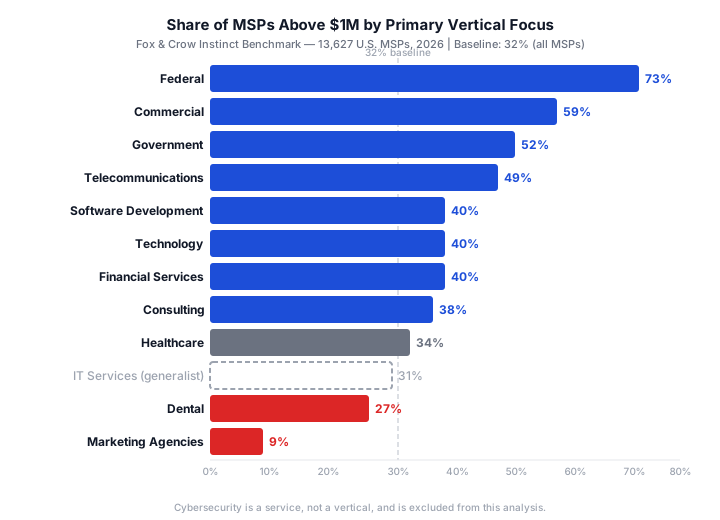 MSP above-$1M rate by vertical focus — Fox & Crow Instinct 2026
Want to see where your MSP stands against local competitors?
Fox & Crow Instinct benchmarks MSPs against the signals that showed up in the data: visibility, tenure, tooling, hiring, target-market posture, vertical focus, and regional competition.
FAQ
How many verticals should an MSP focus on?
An MSP should focus on one primary vertical while it is building its positioning and proof base. Two verticals are manageable if they share compliance characteristics or buyer types. Three or more verticals is, in practice, no vertical at all — it's a broad SMB play with different landing pages. Focus compounds. Spread dilutes.
Can a small MSP compete against larger firms in a vertical?
A small MSP can outcompete larger firms in a vertical because vertical credibility is built on depth, not size. A five-person shop that has served 15 dental practices and knows the specific compliance and software integration requirements of that market will beat a 50-person generalist in that conversation every time. The smaller firm doesn't have less to offer. It has more relevant experience and faster access to decision-makers.
How long does it take to build a defensible MSP vertical strategy?
Building a defensible MSP vertical strategy can take many months or longer, from the decision to focus to developing a presence that generates referrals without direct outbound effort. Early work often includes serving initial clients and documenting outcomes, followed by visibility in vertical communities, case studies, and compliance language. Referral momentum develops on a timeline that varies by market and the strength of the MSP's proof.
What if my target vertical is already crowded with other MSPs?
If your target vertical is already crowded, you have two choices: go narrower within the vertical (a specific employee size, a specific compliance tier, a specific geography) or pick an adjacent vertical that is underserved. "Healthcare" as a vertical is crowded in most metros. "Oral surgery practices in multi-location groups" is not. The narrower the niche, the less competition and the stronger the referral network.
How do I know if my MSP's current niche is a ceiling or a launchpad?
Your MSP niche is a ceiling if your per-seat MRR has been flat despite client growth, if referrals from clients lead only to similar-budget prospects, and if the buyers in your target vertical don't have growing IT requirements. It's a launchpad if compliance pressure creates ongoing demand, if peer referral is active in the community, and if your best clients have grown their footprint over time. Review your last 24 months of MRR per client and referral source data — those two numbers tell the story.