
The Climb Out of SMB: Why Growing MSPs Stop Selling to Everyone
Originally published

Listen to this article
Browser text-to-speech
Methodology note: Fox & Crow Instinct analyzed publicly observable signals from 13,627 U.S. MSPs in 2026. Staff bands are used as a revenue proxy: 1–10 staff ≈ sub-$1M; 11+ staff ≈ above $1M.
Table of Contents
- The SMB Trap Is Comfortable Until It Isn't
- What an MSP ICP Does for Your Pipeline
- Moving Upmarket Isn't About Chasing Whales
- Why MSPs Resist Narrowing Their Target Market
- Making the Shift Without Blowing Up Your Revenue
- What the Data Tells Us
- FAQ
Selling to everyone is a choice. Most MSPs don't realize they made it.
When your MSP is young, saying yes to anything with a pulse and a credit card makes sense. You need MRR. You need logos. You need to keep the lights on. But at some point, that instinct stops being survival strategy and starts being the ceiling. And a lot of MSP founders hit that ceiling and spend years wondering why growth stalled, when the real answer is sitting in their client list.
I cover the broader version of this problem in my guide to the MSP growth ceiling, which makes the case that flatlined growth is a go-to-market problem, not a service delivery problem. This post is about one specific piece of that: the decision to define who your MSP sells to, and what it costs you when you keep avoiding that decision.
The SMB Trap Is Comfortable Until It Isn't
Here's what the SMB trap looks like in practice.
Your MSP closes five-seat deals. Ten-seat deals. The occasional twenty-seater. Each one feels like a win. You're building MRR. Your team is busy. Your recurring revenue number looks healthy on paper.
Then you try to grow past it.
Maybe you hire a salesperson. Maybe you invest in outbound. Maybe you start running campaigns. And the leads come in, and the conversations happen, and the close rate is fine, but the revenue per client just doesn't move. You're adding clients faster than you're adding real revenue. Your support team is stretched. Your pricing is soft because you're always competing on price against whoever else is quoting the five-seat client.
This is the SMB trap. Small clients aren't bad clients. But building your entire MSP go-to-market strategy around the smallest possible buyer creates structural problems you can't outwork.
The clients are price-sensitive by nature. The deals are short. The referrals they give you lead to more of the same. And your MSP ICP, if you have one written down at all, is so broad it's basically useless.
"The MSP that tries to serve every client size is actually choosing to compete on price forever. You can't build a growth strategy on a foundation of 'we'll take whatever calls us.' At some point, the decision about who you're for is the most important business decision you'll make."
 Quote: Ian Richardson on MSP upmarket strategy and ICP
What an MSP ICP Does for Your Pipeline
Most MSPs define their ICP (ideal client profile) as "companies with 10 to 100 employees in our metro area." That's not an ICP. That's a zip code.
A real MSP ICP tells your sales process who to pursue, who to disqualify, and where to spend time. It tells your outbound team what list to build. It tells your vCIO what QBR conversations to prepare for. It tells your marketing what problem to talk about.
Without it, your MSP target market is everywhere. And when your target market is everywhere, your sales motion is unfocused, your messaging is generic, and you end up competing on price because you haven't given anyone a reason to pay more.
Growing MSPs figure this out, sometimes painfully, by looking at their top ten clients and asking a few questions:
- Which clients have the highest MRR per seat?
- Which clients escalate least?
- Which clients say yes to projects?
- Which clients referred someone worth closing?
- Which clients grew their seat count after signing?
The answer to those five questions usually points to a pattern. A vertical. A seat range. A type of decision-maker. An industry with a compliance driver. Something.
That pattern is your MSP ICP. And once you have it, the MSP upmarket growth conversation gets a lot more concrete.
 Social graphic explaining how a defined MSP ICP improves pipeline focus
Moving Upmarket Isn't About Chasing Whales
When I say upmarket, I'm not talking about landing Fortune 500 accounts. I'm talking about the difference between a 12-seat client and a 45-seat client. Between a client who buys managed services because it's cheaper than hiring IT, and a client who buys because they have regulatory requirements, a growth plan, and a CTO who needs a strategic partner.
That second client pays more. They churn less. They refer peers at the same level. And they're usually not that much harder to find, once your MSP go-to-market strategy is pointed at them.
The problem is that most MSPs never repoint the strategy. They keep the same outbound list criteria, the same messaging, the same pricing structure, and wonder why the same type of client keeps showing up.
Moving upmarket requires a few things your current motion probably doesn't have:
- A defined seat floor. Know the minimum engagement size your MSP can support profitably. Many MSPs find that below a certain seat count, the economics just don't work at managed rates.
- Vertical focus or compliance hooks. Mid-market buyers in healthcare, finance, legal, or manufacturing often have specific compliance requirements that create urgency and justify premium pricing. Generic MSPs lose these deals to specialists.
- A sales process that matches buyer sophistication. A 50-seat professional services firm isn't evaluating IT vendors the same way a 10-seat retail shop is. Your discovery questions, your proposal format, your QBR structure all need to match what that buyer expects.
- Proof your MSP has done it before. Upmarket buyers want references from clients who look like them. If your case studies are all 10-seat clients, you have a credibility gap with the 50-seat prospect.
None of this happens overnight. But it starts with a deliberate decision about your MSP ICP, and the willingness to stop treating every lead as equally worth pursuing.
 Social graphic comparing MSP upmarket positioning with broad SMB targeting
Why MSPs Resist Narrowing Their Target Market
The honest answer is fear.
Narrowing your MSP target market feels like leaving money on the table. If you stop pursuing five-seat clients, what happens when a five-seat client calls you?
Here's what I'd push back on: you're not closing the door. You're just not building your MSP go-to-market strategy around them anymore. There's a difference.
The other fear is that there aren't enough of the right clients in the market. That if you get specific, you'll run out of prospects. This is almost never true in practice. If your sweet spot is 40-seat professional services firms with a compliance requirement in your metro area, you probably have more targets than you think. And even if the list is shorter, you're working it with a message that resonates, which means your conversion rate goes up.
The math usually works out. Fewer pursuits, better fit, higher close rate, higher MRR per client. It beats the alternative: many pursuits, poor fit, long sales cycles, low MRR, high churn.
 Social graphic outlining steps for an MSP to move upmarket
Making the Shift Without Blowing Up Your Revenue
You don't have to fire your SMB clients to move upmarket.
What you do have to do is stop investing your growth resources in replacing them with more of the same. Here's a practical way to start:
Audit your current client base. Identify your top ten clients by MRR per seat, not just total MRR. Look for what they have in common.
Write a real MSP ICP. Include:
- Seat range (minimum and maximum)
- Vertical or industry
- Compliance driver if applicable
- Decision-maker title
- Geography if you're constrained
- Signs the prospect is a bad fit (document these, too)
Rebuild your outbound list criteria. Your list should pull from your ICP definition, not from whatever data source is cheapest. This is where many MSPs underinvest. A well-defined ICP makes list building much more precise.
Update your messaging. Your website, your cold outreach, your discovery questions, your proposals. If they're written for a generic SMB buyer, they're not going to land with the client profile you're trying to attract.
Set a timeline. Moving upmarket is often a multi-quarter shift, not a quarter-end sprint. Build it into your MSP go-to-market strategy as a deliberate initiative with milestones, not an aspiration you revisit at the annual offsite.
Your current SMB clients don't go anywhere. You serve them well, you renew them, you let them refer whoever they refer. But the new logos you're hunting look different now. And that difference compounds over time in your MRR per client, your margin, and your ability to build a team that can support the growth.
What the Data Tells Us
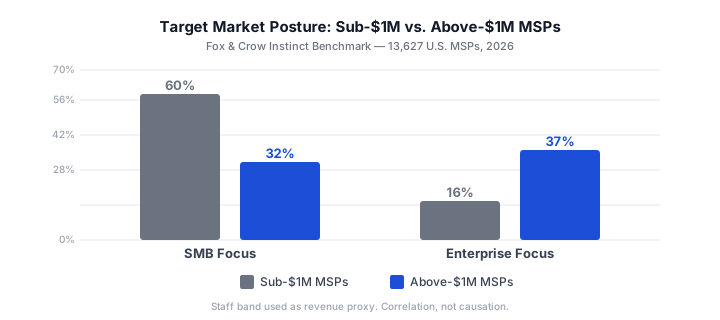 MSP target market posture by staff band — Fox & Crow Instinct 2026
 SMB focus appears among 60% of sub-$1M MSPs compared with 32% of above-$1M MSPs
The Fox & Crow Instinct benchmark of 13,627 U.S. MSPs shows a target-market shift. Among sub-$1M MSPs, 60% position as SMB-focused. Among MSPs above $1M, that figure drops to 32%. Enterprise focus runs in the opposite direction: 16% of sub-$1M MSPs target enterprise clients, versus 37% of $1M+ firms. The vertical and specialist posture shows the same pattern: 7% of sub-$1M MSPs versus 15% of $1M+ firms. These figures represent correlation, not causation. The direction is consistent across the regional cuts in this dataset. MSPs that crossed the threshold are less likely to describe their market as broad SMB than those still below it. A full breakdown of how target-market posture correlates with MSP size is available in the Fox & Crow Instinct MSP growth report.
Want to see where your MSP stands against local competitors?
Fox & Crow Instinct benchmarks MSPs against the signals that showed up in the data: visibility, tenure, tooling, hiring, target-market posture, vertical focus, and regional competition.
FAQ
Why do so many MSPs struggle to define their MSP ICP?
MSPs struggle to define their MSP ICP because defining it feels like admitting you can't serve everyone, and in the early years of an MSP, serving everyone is exactly what kept the business alive. The habit sticks. The instinct to say yes to any deal is hardwired into the founder, and retraining that instinct requires looking honestly at which clients are profitable, not just which clients signed a contract.
How does a narrow MSP target market affect outbound prospecting results?
A narrow MSP target market dramatically improves outbound results because your messaging can be specific to a buyer's actual situation. When your MSP outbound motion is built around a defined vertical, seat range, and decision-maker, the conversations you start are warmer, the discovery questions are sharper, and the prospects you reach are more likely to be evaluating the same things your MSP is built to solve. Generic outreach gets generic results.
What should an MSP ICP include at minimum?
Your MSP ICP should include at minimum: a seat range with a floor you won't go below, a vertical or industry focus, the title of the person who signs the contract, and at least two disqualifiers that tell your team when to walk away. MSPs that skip the disqualifier list end up with an ICP that sounds specific but still lets every lead through.
When does MSP upmarket growth start to show up in revenue?
MSP upmarket growth can show up in revenue gradually, often with MRR per client improving before total MRR climbs. The timing of per-client revenue improvement varies after an MSP narrows its target market and aligns its outbound list, messaging, and proposal structure with the new ICP. Changing the ICP on paper while leaving the sales motion unchanged rarely changes results.
Does moving upmarket mean an MSP has to fire existing small clients?
Moving upmarket doesn't mean your MSP has to fire existing small clients. It means your MSP stops building its growth motion around acquiring more of them. Existing clients get served. But new logo investment — including outbound campaigns, content, and sales capacity — gets pointed at the client profile you've decided to grow toward. The mix shifts over time without any dramatic housecleaning.