
More Services Will Not Fix a Flatlined MSP

Listen to this article
Browser text-to-speech
Methodology: Fox & Crow Instinct analyzed publicly observable web, social, review, hiring, DNS, census, and technology signals for 13,627 U.S. MSPs in 2026. Revenue bands are staff-based proxies: 1–10 staff ≈ sub-$1M; 11+ staff ≈ above $1M. Unless noted, statistics refer to this dataset.
Table of Contents
- Why the "Add More Services" Instinct Is Wrong
- Step 1: Diagnose the Actual Problem
- Step 2: Audit Your MSP Service Menu for Clarity
- Step 3: Fix the Outbound Motion Before Changing the Offer
- Step 4: Earn MSP Differentiation Through Specificity
- What Goes Wrong When MSPs Skip These Steps
- Summary Checklist
- What the Data Tells Us
- FAQ
If your MSP is not growing, adding a new service line is probably the worst thing you can do next.
I know that's not what the vendor roadshows are selling. I know it's not what the distributor reps are pitching when they call. But I've watched MSP after MSP try to solve a go-to-market problem with a product decision, and it does not work. It makes things worse.
By the end of this post, you'll know exactly how to diagnose whether your MSP growth problem is a service problem or a sales and marketing problem, and you'll have a step-by-step process for fixing the right one. If you've read the broader piece on MSP growth ceilings and why managed service providers flatline, you already know this is almost always a go-to-market failure. This post is about what to do about it.
Why the "Add More Services" Instinct Is Wrong
When revenue stalls, the instinct is to look at what you're selling.
Maybe you need SOC services. Maybe you need to add BCDR (backup and disaster recovery) as a managed offering. Maybe you need to build out vCIO capabilities or co-managed IT packages. The service menu feels like the answer because it's something you can control. You can research it, price it, and launch it. That momentum feels productive.
Productive is the wrong word. This is avoidance.
The MSP service offering is rarely why growth flatlines. Your prospects don't know what's on your service menu. They don't comparison-shop your stack against a competitor's stack. They buy from the MSP they've heard of, been referred to, or talked to when they were ready to make a change. If your MSP isn't getting in front of new prospects consistently, a better service menu doesn't fix that. A new stack of services with no outbound motion behind it just sits there.
So before you spend money on a new platform or spend six months training your team on a new offering, do this first.
"Every MSP owner I've talked to who added a new service line to fix a revenue problem ended up with the same revenue problem and a harder service to explain. The offer was never the issue. The pipeline was."
 Quote: Ian Richardson on MSP service breadth and pipeline
Step 1: Diagnose the Actual Problem
Pull your last 12 months of closed-won and closed-lost data out of your CRM.
If you don't have that data, that is your first problem. Start there.
For MSPs that do have it, sort by closed-lost reason. Look at what you're seeing:
- Lost to incumbent (the prospect stayed with their current MSP)
- Lost to a competitor (another MSP won the deal)
- Lost to price (they went with a cheaper option)
- Lost because the prospect went dark and never decided
- Lost because you couldn't clearly articulate differentiation
Now look at closed-won. How did those deals find you? Referral? Cold outreach? Event? Inbound from your website? How long did those sales cycles run?
If your closed-lost reasons are dominated by "prospect went dark" or "couldn't differentiate," your MSP service offering is probably fine. Your MSP sales process is broken. If you have almost no closed-lost data because you're not generating enough new conversations to lose deals in the first place, the problem is pipeline. Your outbound motion is either nonexistent or it's failing.
Neither of those problems is solved by adding MDR to your stack.
 MSP service menu illustration focused on diagnosing growth problems
Step 2: Audit Your MSP Service Menu for Clarity, Not Breadth
Once you've ruled out a genuine gap in what you offer, look at how you're presenting what you already sell.
This is where most MSP service menus quietly die. The services exist. The pricing is reasonable. The delivery is solid. But no one outside your company can explain what you do in a sentence.
Sit down with someone who is not in your industry and describe your MSP service offering to them. If they cannot repeat it back to you in plain language, you have a messaging problem. That problem will not be fixed by adding another service. It will get worse.
Clean up your core offer first.
For most MSPs, this means picking one to three service tiers, naming them simply, and being able to explain what's included and what it costs without sending a twelve-page proposal. It means building your positioning around a specific kind of client, a specific industry, or a specific business size — not around your stack.
A 30-seat MSP with sharp positioning in one vertical may close deals faster than a similarly sized MSP with a sprawling service menu and no focus.
Ask yourself these questions:
- Can your salespeople explain your offering in 90 seconds on a cold call?
- Does your service menu map to a specific ICP (ideal customer profile), or is it built to cover every possible objection from any possible prospect?
- When you lose a deal, is the prospect confused about what they're buying, or are they clear on it and choosing someone else?
The answers will tell you whether your MSP differentiation problem is a breadth problem or a clarity problem. Almost always, it's clarity.
Step 3: Fix the Outbound Motion Before Changing the Offer
If your MSP isn't generating enough new pipeline, that is a prospecting and sales development problem.
Here is what I see constantly: an MSP owner concludes that the reason they're not winning new business is that they don't have enough to sell. So they add services, build new collateral, retrain the team, and delay prospecting while all of that is getting stood up. Six months later, the pipeline is still empty and now they have a more complicated service menu to explain.
Don't do that.
Fix the outbound motion first. That means:
- Having a defined list of target accounts that fit your ICP
- Running a consistent outbound calling cadence, not a sporadic one
- Tracking dials, conversations, and appointments as separate metrics
- Following up on every qualified conversation until the prospect buys, goes with a competitor, or explicitly opts out
If your MSP is doing relatively few outbound touches across prospecting channels, you may not have enough pipeline activity to know whether your service offering is the problem. You may simply have too little data.
Get the volume right first. Then let the call reports and the closed-lost data tell you if there's a genuine service gap.
 MSP outbound process illustration before changing services
Step 4: Earn MSP Differentiation Through Specificity, Not Feature Lists
Real MSP differentiation doesn't come from what's on your service menu. It comes from who you serve and how well you understand their specific problems.
One of the clearest examples I can give you: two MSPs, similar stack, similar pricing, similar market. One wins consistently in healthcare-adjacent businesses because every conversation they have references HIPAA, business associate agreements, and the specific compliance headaches that sector carries. The other MSP talks about their NOC, their ticketing system, and their response times. Same services. Completely different result.
Specificity builds trust in a way that feature lists don't.
If you want genuine MSP differentiation, pick a vertical, an employee size band, or a geography and go deep on the problems those businesses have. Build your language around their risks, not your tools. That is the fastest path to being the MSP they call instead of the MSP they evaluate.
 MSP differentiation illustration emphasizing vertical expertise
What Goes Wrong When MSPs Skip These Steps
The most common mistake I see is layering new services on top of a broken sales process because it feels easier than fixing the process.
New services require new training. New vendor relationships. New collateral. New pricing conversations. New delivery capacity. They create internal complexity before they create a single new dollar of MRR.
And when the new service doesn't generate the growth you hoped for, the temptation is to try the next one.
That cycle kills MSPs. Not quickly. Slowly. You end up with a bloated MSP service menu, a team that's stretched thin trying to deliver across too many disciplines, and a sales conversation that confuses prospects instead of converting them.
Stop adding. Start clarifying.
The other mistake is building your MSP differentiation strategy around what your competitors are offering. If a competitor is selling SOC services and winning deals, it's tempting to conclude you need SOC services too. But you don't know why they're winning those deals. It might be the SOC offering. It might be their sales team, their referral network, or the fact that they've been calling the same 200 companies for three years. Don't copy the output. Understand the input.
Summary Checklist
Before you add a single new service to your MSP service menu, work through this list:
- Pull and review 12 months of closed-lost reasons from your CRM
- Identify whether your primary problem is pipeline volume, conversion rate, or genuine service gaps
- Audit your existing MSP service offering for clarity, not breadth
- Verify that a non-technical person can explain your offer after hearing it once
- Confirm your outbound prospecting activity is consistent and measured, not sporadic
- Define or sharpen your ICP before adding new services to chase new buyer types
- Check whether your MSP differentiation messaging references your client's specific risks, or just your own tools
- Only add a new service if closed-lost data shows you are consistently losing deals because of a specific service gap, not because of a messaging or pipeline problem
What the Data Tells Us
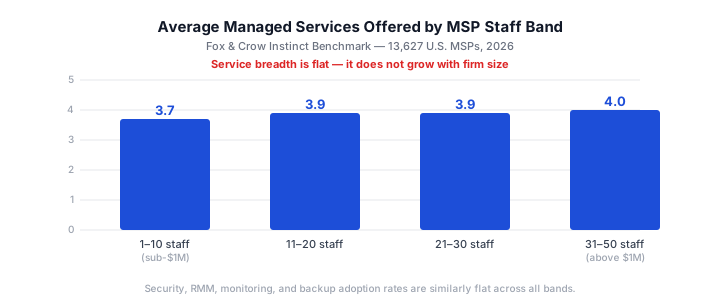 Service breadth by MSP staff band — Fox & Crow Instinct 2026
 Average managed services offered: 3.7 for sub-$1M MSPs and 3.9 for the next staff band
The Fox & Crow Instinct benchmark of 13,627 U.S. MSPs makes the service breadth case plainly: average managed services offered is 3.7 for sub-$1M shops and 3.9 for the next band. It does not move meaningfully as firms get larger. Security tooling — RMM, monitoring, backup — shows the same flat pattern across all staff bands. The MSPs that crossed $1M did not do it by adding more services. Their menus are, in the aggregate, nearly identical to the ones still under $1M. What changed is everything else: visibility, positioning clarity, target-market focus, and operational maturity. The correlation does not prove that a narrow menu causes growth, but the direction is unambiguous — breadth is not the variable. A detailed breakdown of how service signals compare across MSP size bands is available in the Fox & Crow Instinct MSP growth report.
Want to see where your MSP stands against local competitors?
Fox & Crow Instinct benchmarks MSPs against the signals that showed up in the data: visibility, tenure, tooling, hiring, target-market posture, vertical focus, and regional competition.
FAQ
Why isn't adding more services helping my MSP grow?
Adding more services isn't helping your MSP grow because growth problems in managed services are almost never caused by what's on the service menu. MSPs flatline because of pipeline failures, weak outbound motions, and unclear positioning — not because they're missing a service tier. If your MSP isn't getting in front of qualified prospects consistently, a broader offering gives those prospects more to be confused by, not more reasons to buy.
How does an MSP know if it has a service gap or a sales process gap?
An MSP knows it has a genuine service gap when closed-lost data repeatedly shows the same specific missing capability as the stated reason for losing. If prospects are choosing competitors because of a feature your MSP doesn't offer, that's a service gap. If prospects are going dark, choosing incumbents, or struggling to articulate why they didn't buy, that's an MSP sales process gap. One requires a product decision. The other requires a go-to-market fix.
What does real MSP differentiation look like if it's not about the service menu?
Real MSP differentiation comes from specificity in who you serve and how well you speak their language. An MSP that positions around a specific vertical, company size, or compliance environment wins conversations that a generalist MSP loses, even when the underlying services are identical. Your MSP service offering matters far less than your ability to make a prospect feel understood in the first conversation.
How much MSP outbound activity is enough before I can evaluate my offer?
Your MSP needs enough outbound activity to generate statistically meaningful closed-lost data. That generally means running a consistent prospecting cadence for at least 60 to 90 days before drawing conclusions about your offer. MSPs running fewer than 40 outbound touches per week don't have enough pipeline data to know whether the problem is the service, the message, or the volume. Get the volume up first.
When should an MSP expand its service menu?
An MSP should expand its service menu when two things are true: the existing sales motion is generating consistent new logos, and closed-lost data shows a repeating pattern of deals lost to a specific missing capability. If both conditions are met, adding that service makes sense. If only one is true, or neither is, adding services is a distraction from the real fix.