
The Map of MSP Opportunity Is Not the Map of MSP Competition

Listen to this article
Browser text-to-speech
Methodology: This Fox & Crow Instinct analysis covers 13,627 U.S. MSPs in 2026 using publicly observable web, social, review, hiring, DNS, census, and technology-detection signals. Staff bands are used as a revenue proxy: 1–10 staff approximates sub-$1M, while 11 or more staff approximates above $1M. Statistics refer to this dataset unless noted otherwise.
Table of Contents
- What the data says about MSP market density
- Competition clusters where MSPs feel comfortable
- Where the buyers are
- Why MSP competitive analysis gets done wrong
- Building an MSP territory strategy around density gaps
- The mistake of copying your competitor's territory
- FAQ
Most MSPs are fighting over the same ten zip codes while ignoring the next fifty.
That's not a sales problem. It's a geography problem nobody bothered to diagnose.
If your MSP business is stuck, the honest question to ask isn't "Why can't we win against the competition?" It's "Why are we targeting the same accounts our competitors are?" MSP market density can shape your win rate, and many MSPs have never measured it.
The direct answer to what this post is built around: MSP market opportunity and MSP competition do not overlap neatly. The places where managed services buyers are underserved are not the same places where your competitors are prospecting. Finding that gap is a legitimate go-to-market strategy. Ignoring it means paying premium effort for below-average results in markets that are already crowded.
The broader go-to-market breakdown is covered in The MSP Growth Ceiling. This post is about the specific territory and density question: how do you find where buyers exist but competition doesn't?
This post is part of Fox & Crow's Q3 2026 MSP Flatline series. The full diagnosis is in The MSP Growth Ceiling.
What the data says about MSP market density
Fox & Crow Instinct analyzed MSP density per capita across U.S. states. The spread is roughly 8x from the most saturated market to the most underserved.
Most saturated (MSPs per 100,000 residents):
| State | MSPs per 100K |
|---|---|
| DC | 15.8 |
| Delaware | 12.1 |
| New Hampshire | 11.7 |
| Wyoming | 10.6 |
| Maryland | 10.1 |
| Virginia | 10.0 |
Most underserved:
| State | MSPs per 100K |
|---|---|
| Mississippi | 2.0 |
| Arkansas | 3.5 |
| Alabama | 4.0 |
| Kentucky | 4.0 |
| South Carolina | 4.1 |
DC has 15.8 MSPs per 100,000 residents. Mississippi has 2.0. That roughly eightfold spread suggests meaningful differences in observed MSP density. The DC/Maryland/Virginia govcon corridor and the Northeast appear comparatively dense, while several Deep South markets appear less dense. These figures reflect Instinct's discovery coverage, not a government census—treat them as directional and relative, not absolute counts.
Want to see where your MSP stands against local competitors?
Fox & Crow Instinct benchmarks MSPs against the signals that showed up in the data: visibility, tenure, tooling, hiring, target-market posture, vertical focus, and regional competition.
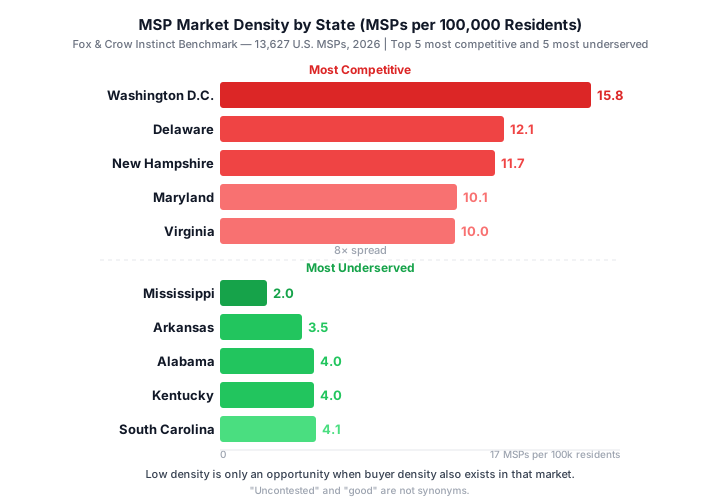 State-by-state MSP density observed in the Fox & Crow Instinct benchmark study
 Comparison of observed MSP density in DC and Mississippi
"The market your competitors are ignoring isn't uncontested because it's bad. It's uncontested because everyone followed the same instinct to prospect close to home. That's a habit, not a strategy. And habits don't build MSPs; decisions do."
 Ian Richardson quote about using territory strategy instead of familiar prospecting habits
Competition clusters where MSPs feel comfortable
MSPs tend to concentrate around the same business corridors.
Downtown cores. Suburban office parks. Mid-sized cities with a visible tech scene.
Why? Because that's where the MSP owner lives, where they went to BNI for the first time, where their first three clients happened to be. Territory decisions get made by accident and then defended as strategy.
The result is MSP market density that looks nothing like buyer density.
A 20-seat MSP I worked with had seventeen active prospects in a three-mile radius of their office. They were proud of that pipeline. What they hadn't noticed was that six other MSPs were working the same three-mile radius. Their close rate was declining. They called it a sales problem. It was a territory problem.
MSP competitive analysis in that situation isn't about pricing or features. It's about recognizing you've wandered into a firefight you didn't need to enter.
 Illustration of MSP competitor concentration in a local territory
Where the buyers are
Buyer density and competitor density diverge in predictable ways.
Second-tier suburban markets can be underserved, as can industrial corridors, light manufacturing clusters, specialty trades, agricultural supply chains, and regional healthcare networks outside major metros. These buyers may have real IT spend. Some are running break-fix relationships they dislike and may not have received a relevant managed services pitch.
They're not hard to find. They're just not glamorous.
MSP territory strategy built around buyer density instead of personal comfort tends to produce a different sales experience. Less objection about incumbent relationships. Less price compression from competitors undercutting each other. More prospects who haven't already had twelve MSPs pitch them this quarter.
Competition can shape the sales environment. If several MSPs are calling a company, earning attention may be harder than when fewer providers are active. Actual outcomes still depend on fit, timing, and execution.
How to measure it in your market:
- Pull a list of businesses in your serviceable radius that match your ICP criteria: employee count, industry, technology dependency.
- Cross-reference against what you know about where your competitors advertise, sponsor events, and source referrals.
- Identify clusters where ICP-matching companies exist but competitor activity is low or invisible.
- That gap is your territory.
 Illustration of a territory map comparing buyer and competitor density
Why MSP competitive analysis gets done wrong
Most MSP competitive analysis is really just competitor obsession.
Who lowered their price. What their new hire posted on LinkedIn. Whether they won that account you wanted.
That's hearsay, not analysis.
Real MSP competitive analysis asks structural questions:
- Where are competitors active, and where aren't they?
- What buyer segments are they ignoring because of their own ICP assumptions?
- What verticals are they avoiding because the sales cycle felt too long once?
- What geographies are outside their delivery comfort zone?
The answers to those questions can indicate where the market may be open. The alternative—watching what competitors do and then trying to do it better in the same place—can be a legitimate strategy, though it may require more time and investment.
One partner I spoke with in the mid-Atlantic had spent three years competing directly against two larger MSPs for the same pool of professional services firms. Win rate was low. Cost per acquisition was high. They finally asked where those two competitors weren't active.
The answer was regional nonprofits and small healthcare-adjacent practices in their secondary market.
Those buyers had budget, had pain, and had never received a proper managed services proposal.
Pipeline filled faster than anything they'd built in the previous three years.
 Illustration of a territory opportunity beyond a competitor's core market
Building an MSP territory strategy around density gaps
MSP territory strategy isn't about drawing a circle on a map and calling everything inside it your territory.
It's about understanding where density of qualified buyers exceeds density of active competition.
That ratio is your opportunity score.
High buyer density plus high competitor density equals a hard market. You can win there, but you'll pay for every win.
High buyer density plus low competitor density may indicate a promising market. It can create room to test pipeline development, pricing, and positioning with less direct pressure.
Low buyer density regardless of competition is just a bad market. Don't confuse "uncontested" with "good."
Where to start building your MSP territory map:
- Define your actual ICP. Not aspirationally. Who have you closed and retained? What do they look like? Employee range, industry, how they currently consume IT, what their trigger event was.
- Map them geographically. Where do your existing clients sit? Are they clustered, or scattered?
- Layer in competitor activity. Where do you see competitor event sponsorships, LinkedIn ads, and referral partner overlap?
- Identify white space. Markets with ICP-matching companies and no competitor fingerprint. That's where your next outbound motion starts.
- Validate with outbound. A focused outreach test into the white space can help determine whether your map is accurate.
The territory map isn't a permanent document. Competitors move. Markets mature. An underserved vertical in your region won't stay underserved indefinitely once someone figures out it converts well.
An MSP that maps and enters a market early may have more opportunity to build reference relationships in that vertical.
The mistake of copying your competitor's territory
There's a version of MSP competitive analysis that produces the opposite of strategy.
You watch what a competitor is doing. They're sponsoring a chamber event in a specific suburb. They just hired a business development rep who used to sell to dental groups. They're running LinkedIn ads targeting construction firms with fifty-plus employees.
So you do the same thing.
Now you're chasing the same buyers they've already been warming up. You're not competing on quality. You're competing on timing, and you started late.
Competitor behavior tells you where the market is already contested. Following it means you've decided to fight rather than find.
The better read is this: if a competitor is investing heavily in a vertical or geography, they've probably already validated that buyers exist there. That's useful information. But the implication isn't "go there too." It's "what's adjacent to that, where they haven't gone yet?"
Copy their insight. Not their territory.
FAQ
What is MSP market density and why does it matter for MSP growth?
MSP market density refers to the ratio of qualified managed services buyers to active MSP competitors in a given geography or vertical. It matters for MSP growth because a market with many buyers and fewer competitors may create less price pressure than a market where multiple MSPs compete for the same accounts. Measuring density before building an outbound motion can help an MSP assess where pipeline development may be more feasible.
How do MSPs identify where competitors are and aren't active in their market?
MSPs can identify competitor activity by tracking event sponsorships, LinkedIn advertising patterns, referral partner overlaps, and which accounts have already received proposals from known competitors. Outbound outreach is one validation tool: if a prospect says they have spoken to several MSPs recently, that can be a high-density signal. If they say you are the first managed services company to call them, that may be a density gap worth noting.
What is MSP territory strategy and when should an MSP define it?
MSP territory strategy is the deliberate decision about where your MSP will and will not focus prospecting effort, based on where qualified buyers exist relative to where competitors are active. MSPs can define it before building an outbound motion rather than only after a campaign underperforms. Without a defined territory, MSPs may default to familiar geography, which can place them in a more contested part of their market.
How does MSP market opportunity analysis differ from MSP competitive analysis?
MSP market opportunity analysis measures where buyers exist and what their current IT situation looks like. MSP competitive analysis measures where competitors are active and how they're positioned. They're related but different. An MSP doing only competitive analysis will know a great deal about what their competitors are doing and very little about whether there are buyers those competitors have ignored.
Can a smaller MSP compete in a high-density MSP market?
A smaller MSP can compete in a high-density MSP market, though it can be a difficult starting point. One approach is to identify what larger competitors in a high-density market cannot or will not serve: smaller client sizes, niche verticals, secondary geographies, or service models that require more hands-on attention than a scaled MSP wants to deliver. That is not retreating; it is choosing a market where the MSP may have a clearer fit.