
The MSP Trust Gap: Why Email Security Signals Matter More Than You Think
Originally published

Listen to this article
Browser text-to-speech
Methodology: Fox & Crow Instinct analyzed publicly observable web, social, review, hiring, DNS, census, and technology signals for 13,627 U.S. MSPs in 2026. Revenue bands are staff-based proxies: 1–10 staff ≈ sub-$1M; 11+ staff ≈ above $1M. Unless noted, statistics refer to this dataset.
Table of Contents
- What DMARC signals to your prospects
- What the data says
- Why your MSP sales outreach gets blocked
- The credibility contradiction MSPs cannot afford
- Getting MSP DMARC right without overcomplicating it
- What clean email authentication does for your MSP pipeline
- FAQ
Your competitors are training your prospects to distrust your emails before you've sent a single cold outreach.
Not because of what's in the emails. Because of what's missing from the technical setup behind them.
MSP DMARC configuration, SPF alignment, and DKIM signing are not just IT hygiene tasks. They are trust signals. When your MSP sells cybersecurity services to prospects concerned about phishing and email fraud, showing up in their inbox without proper email authentication can create a contradiction that is difficult to explain away.
This post answers one specific question: why does MSP email security configuration matter for sales and growth, not just for compliance? The broader go-to-market dynamics behind MSP growth ceilings are covered in The MSP Growth Ceiling. This post is narrower. It's about what your email domain says about your MSP before your prospect reads a single word you wrote.
This post is part of Fox & Crow's Q3 2026 MSP Flatline series. The full diagnosis is in The MSP Growth Ceiling.
What DMARC signals to your prospects
DMARC (Domain-based Message Authentication, Reporting and Conformance) tells a receiving mail server what to do when an email claims to be from your domain but fails authentication checks.
That's the technical definition.
Here's the business definition: DMARC tells your prospect whether you've done the minimum required to protect your own domain from being spoofed.
When an MSP pitches cybersecurity services without a published DMARC record, there's a gap. The prospect's IT person, or their current MSP, can check this in about 30 seconds. Many of them do. And when they find nothing, or find a DMARC policy set to p=none (which monitors but doesn't enforce), the implicit message is that your MSP doesn't hold itself to the standard it's selling.
That's a hard position to recover from in a sales conversation.
SPF and DKIM matter too.
SPF (Sender Policy Framework) specifies which mail servers are authorized to send on behalf of your domain. DKIM (DomainKeys Identified Mail) adds a cryptographic signature to your outbound email so the receiving server can verify the message wasn't tampered with in transit.
All three working together — SPF, DKIM, and DMARC — form a baseline for MSP email security credibility. Missing one can be a visible gap to someone who knows where to look.
"Your MSP's domain is a publicly auditable record of whether you practice what you sell. A prospect who checks your DMARC configuration before the first meeting is doing exactly what a good IT buyer should do. If they find a gap, the trust problem isn't fixable with a better slide deck."
 Quote: Ian Richardson on MSP DMARC and email security credibility
What the data says
Fox & Crow Instinct analyzed DNS records across 13,627 U.S. MSPs. SPF is widespread — about 96% of MSPs have it configured. DMARC enforcement is where the gap appears.
| Band (staff) | SPF | DMARC present | DMARC enforced | Monitor-only |
|---|---|---|---|---|
| 1–10 (sub-$1M) | 95% | 72% | 43% | 28% |
| 11–20 | 97% | 81% | 49% | 32% |
| 21–30 | 97% | 79% | 49% | 30% |
| 31–50 | 98% | 83% | 53% | 30% |
Among MSPs that sell security services, 51% enforce DMARC; among those that do not, 37%. Security-selling MSPs show higher enforcement in this dataset, but even among them only about half enforce DMARC. Roughly 30% of all MSPs run DMARC in a monitor-only mode that blocks nothing.
 DMARC enforcement comparison between sub-$1M MSPs and MSPs with 31–50 staff
Want to see where your MSP stands against local competitors?
Fox & Crow Instinct benchmarks MSPs against the signals that showed up in the data: visibility, tenure, tooling, hiring, target-market posture, vertical focus, and regional competition.
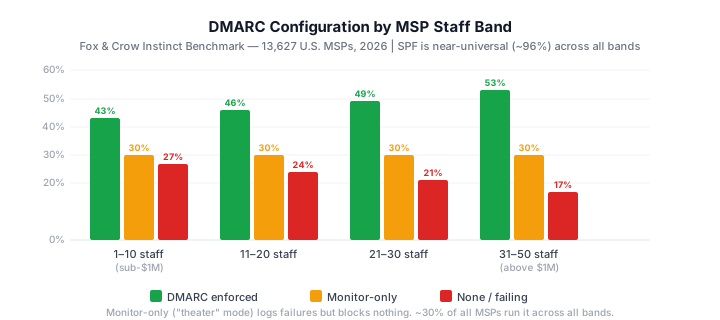 MSP DMARC enforcement by staff band, Fox & Crow Instinct 2026
 MSP email authentication illustration showing DMARC enforcement
Why your MSP sales outreach gets blocked
Here's a scenario that happens more often than most MSPs realize.
Your BDR sends a targeted batch of cold emails to a prospect list. Open rates look okay. Replies are thin. You assume the messaging needs work.
But the real problem is that a portion of those emails never arrived. Some went to spam. Some were rejected outright. And if your domain has no DMARC record, or a weak one, some receiving environments flagged your outreach as suspicious before a human ever saw it.
You can't sell to a prospect who never got your email.
MSP email security configuration can affect deliverability. Mail servers at larger organizations — and organizations that have invested in email filtering and security tools — may consider your domain's reputation as part of the delivery decision. A domain with no DMARC policy, misaligned SPF records, or no DKIM signing may receive less trust, increasing the risk of rejections or spam-folder placement.
The compounding problem.
If your outbound volume is high and your domain reputation is degraded, you risk being flagged at the domain level, not just the message level. That can affect your entire domain's deliverability, including transactional emails, client communications, and renewal notices.
Fix the authentication first. Then evaluate the messaging.
 MSP outbound email illustration highlighting authentication and deliverability
The credibility contradiction MSPs cannot afford
I've talked to MSPs who have spent years building a reputation as a cybersecurity-forward firm. They lead with security in their pitch. They offer vCIO services. They push compliance frameworks. They present QBR decks with threat landscape summaries.
And then a technically curious prospect runs a quick DMARC check on their domain and finds it's either missing or set to monitor-only.
The conversation changes after that.
MSP cybersecurity trust is earned through consistency between what you say and what you do. Prospects who are evaluating you as a potential IT partner are looking, consciously or not, for evidence that you operate the way you advise others to operate. Your own domain's email authentication record is one of the most publicly verifiable pieces of that evidence.
This isn't about perfection. It's about not handing a skeptical prospect an easy reason to walk.
What a prospect's IT person sees when they check:
- Whether a DMARC record exists
- What the policy enforcement level is (
none,quarantine, orreject) - Whether your SPF record is correctly configured and not over the lookup limit
- Whether DKIM is signing your outbound mail
A policy of p=reject with aligned SPF and DKIM signals that your MSP has its own house in order. A missing record, or p=none, signals the opposite.
 MSP DMARC setup illustration showing email security checks
Getting MSP DMARC right without overcomplicating it
The good news: this is fixable, and it's not a months-long project.
Audit your current state first.
Use a public lookup tool to check your domain's DMARC record, SPF record, and DKIM configuration. Look at every domain your MSP sends from — your primary domain, marketing subdomains, and domains associated with tools that send on your behalf.
Get to p=quarantine or p=reject.
Starting at p=none can be appropriate for a monitoring period, but staying there indefinitely limits the record's protection. The goal for DMARC for MSPs is enforcement. Set a timeline to move through the policy levels. The time needed to reach p=reject depends on a complete inventory of sending sources.
Align your sending sources.
Every platform that sends email on behalf of your domain — your PSA, marketing tool, ticketing system, or BDR's sequencing tool — needs authorization in your SPF record and should ideally use DKIM signing. More than 10 SPF include lookups exceeds the lookup limit and can break authentication.
Set up DMARC reporting.
DMARC aggregate reports (RUA) show you which sources are sending mail from your domain and whether they're passing authentication. Read them. They'll surface shadow IT email sending you didn't know was happening.
Don't skip the internal audit.
Before you push clients toward DMARC compliance, confirm your own MSP has completed this process. The credibility cost of a prospect discovering your own gap is higher than the time cost of fixing it.
What clean email authentication does for your MSP pipeline
Proper MSP email security configuration does three concrete things for your sales motion.
First, it improves deliverability. More of your outbound prospecting emails reach the inbox. That means more opens, more replies, and more conversations started without any change to your messaging.
Second, it protects your domain reputation over time. A degraded sender reputation is hard to recover. Maintaining clean authentication from the start prevents the slow erosion that comes from high-volume outbound on an unprotected domain.
Third, it removes a credibility objection before it surfaces. Prospects who check won't find a gap. That's not a small thing when your MSP is selling security services and trust is the product.
None of this replaces good outreach, good targeting, or a compelling offer. But it removes a preventable obstacle from a sales process that already has enough of them.
FAQ
Why should an MSP care about DMARC if it seems like a technical issue, not a sales issue?
An MSP should care about DMARC because technical configuration can influence sales credibility. A prospect evaluating your MSP for cybersecurity services, or their current IT staff, may check publicly visible signals about your domain's security posture. DMARC is one of those signals. A gap can create doubt in deals that may otherwise have progressed.
How does poor MSP email security configuration affect cold outreach deliverability?
Poor MSP email security configuration affects cold outreach deliverability by lowering your domain's trust score with receiving mail servers. Environments with active email security filtering will route messages from unauthenticated or weakly authenticated domains to spam or reject them outright. Your MSP's outbound sequence may be generating activity in your sequencing tool while producing no inbox placements at the destination.
What DMARC policy level should an MSP be at?
Your MSP should aim for p=reject, with p=quarantine as an acceptable interim enforcement level. Starting at p=none for a monitoring period is reasonable, but MSPs that stay at p=none indefinitely are not getting the protection or credibility signal the record is meant to provide.
Can an MSP's email domain reputation recover once it's been damaged?
An MSP's email domain reputation can recover, but it takes longer than it takes to damage it. The process involves fixing authentication, reducing complaint rates, warming the domain back up with lower-volume sends, and waiting for blacklists and filtering systems to update. Prevention is meaningfully cheaper than recovery, both in time and in pipeline opportunities missed during the repair period.
What's the first step for an MSP that has never configured DMARC?
The first step for an MSP that has never configured DMARC is a full audit of every domain the MSP sends from and every platform authorized to send on its behalf. Inventory the sending sources before publishing any DMARC record. Publishing DMARC before you know all your sending sources will cause legitimate mail to fail authentication, which creates a different problem. Audit first, then configure.