
Loud-but-Small MSPs: What Stalled Firms Can Learn From the $1M MSPs-in-Waiting

Listen to this article
Browser text-to-speech
Methodology: This Fox & Crow Instinct analysis covers 13,627 U.S. MSPs in 2026 using publicly observable web, social, review, hiring, DNS, census, and technology-detection signals. Staff bands are used as a revenue proxy: 1–10 staff approximates sub-$1M, while 11 or more staff approximates above $1M. Statistics refer to this dataset unless noted otherwise.
Table of Contents
- What "loud-but-small" means for your MSP
- What the data says
- The MSP visibility benchmark problem
- What stalled MSPs can steal from this playbook
- Why $1M MSPs-in-waiting look different from the outside
- Where to start if your MSP is the stalled one
- FAQ
The MSPs closest to breaking $1M aren't always the ones with the best service delivery.
Sometimes they're the ones who figured out how to look like they already crossed that line.
I've worked with enough sub-$1M MSPs to recognize the pattern. There's a certain kind of firm that shows up everywhere: active on LinkedIn, presenting at local events, referenced in peer groups, quoted in community threads. They carry real weight in conversations. Their name comes up. And then you look at their actual revenue, and it doesn't match the footprint at all.
That's not a criticism. It's a data point worth studying.
Because firms that are genuinely stalled—the ones that have been at the same MRR for two or three years with no clear reason why—often have the opposite problem. They may be doing excellent work for clients who value them, while few people outside that client list have heard of them.
This post is part of Fox & Crow's Q3 2026 MSP Flatline series. The full diagnosis is in The MSP Growth Ceiling.
What "loud-but-small" means for your MSP
Loud-but-small is a byproduct of a specific decision: to be present in the places where buyers and referral partners pay attention, before the revenue justifies it on paper.
Those MSPs are building pipeline equity. They're creating conditions where, when a buyer finally has a problem that needs solving, their name is already on the list. They're not starting from zero on every new logo conversation.
Stalled MSPs may have limited pipeline equity. They can become heavily dependent on referrals from existing clients and build little external surface area. New-logo opportunities may start cold, even when the firm has been in business for a decade.
The small MSP marketing problem isn't that stalled firms can't afford visibility. It's that they've decided, consciously or not, that visibility is something you earn after you grow. That's backwards.
"The MSPs that break through the ceiling aren't always the ones doing the best work. They're the ones who decided to be visible before the revenue made it feel safe. Waiting until you feel big enough to be seen is how you stay small."
 Ian Richardson quote about building MSP visibility before growth feels safe
What the data says
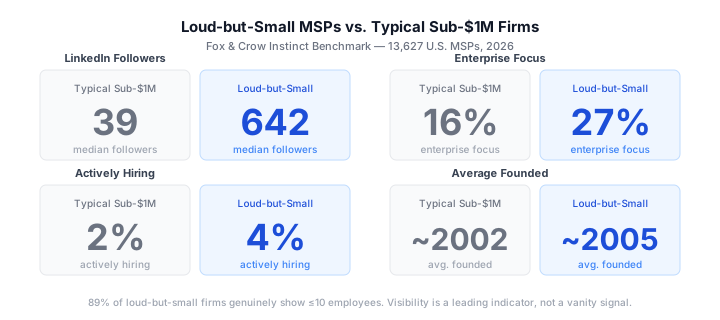
Fox & Crow Instinct identified 446 sub-$1M MSPs with the visibility profile of a much larger firm—roughly 5% of all sub-$1M MSPs in the study. Their median LinkedIn following was 642, compared with 32 for typical quiet sub-$1M MSPs and 361 for MSPs that have crossed the $1M proxy threshold.
Here is what that cohort looks like versus their peers:
| Signal | Loud-but-Small | Quiet Sub-$1M | Above $1M |
|---|---|---|---|
| Median LinkedIn followers | 642 | 32 | 361 |
| Average founding year | 2005 | 2002 | 1998 |
| Enterprise focus | 27% | 15% | 29% |
| Website pages | 58 | 44 | 74 |
| Actively hiring | 4% | 2% | 6% |
And 89% of these firms genuinely have 10 or fewer employees. They are not mismeasured. They are early.
Want to see where your MSP stands against local competitors?
Fox & Crow Instinct benchmarks MSPs against the signals that showed up in the data: visibility, tenure, tooling, hiring, target-market posture, vertical focus, and regional competition.
 Illustration of the visible-market profile of a loud-but-small MSP
The MSP visibility benchmark problem
Here's a useful diagnostic question: if a prospect in your target market searched your firm name right now, what would they find?
For most stalled MSPs, the answer is a website, maybe a LinkedIn company page with 47 followers, and a Google Business Profile that hasn't been touched since the firm launched.
For a loud-but-small MSP, the answer looks completely different. You'd find the owner's LinkedIn with consistent activity, maybe a couple of contributed pieces in MSP-adjacent publications, a few event appearances, and a community presence that makes the firm look like a known entity.
That's the MSP visibility benchmark gap. And it compounds.
Buyers who are evaluating MSPs don't make decisions in a vacuum. They look at social presence, community reputation, and whether other people they trust have heard of the firm. A stalled MSP with no external presence loses deals before the first conversation, because the buyer has already quietly ranked them lower than the firm whose owner they've seen active in two different forums.
 Illustration of the public visibility gap between stalled and loud-but-small MSPs
What stalled MSPs can steal from this playbook
The loud-but-small MSPs aren't doing anything that requires significant budget. They're doing things that require consistency and a decision to be visible.
For stalled MSPs, the three moves worth stealing are:
-
Own a niche publicly. Loud-but-small MSPs tend to be known for something specific. A vertical. A compliance specialty. A geography plus a use case. Stalled firms often resist this because they're afraid of narrowing their potential client base. What they miss is that being known for something specific is what makes you findable and referable.
-
Put the owner on the field. The firms generating noise before the revenue justifies it almost always have a founder or owner who is personally visible. Not the company brand. The person. Buyers buy from people. Referral partners refer people. If you're running a 12-seat MSP and your owner hasn't posted anything in six months, you're invisible to every prospect who isn't already in your orbit.
-
Show up where decisions get made. This means peer groups, local business associations, vertical-specific events, and online communities where your buyers spend time. Not MSP-only spaces where you're talking to other MSPs. The spaces where your buyers are already present and already paying attention.
None of these cost money in the way that paid advertising does. They cost time and the willingness to be seen before you feel ready.
 Illustration of practical visibility moves for stalled MSPs
Why $1M MSPs-in-waiting look different from the outside
The firms I would classify as $1M MSPs-in-waiting—the ones with an estimated $600K to $900K in MRR and visible momentum—share behaviors that may not be reflected in their current revenue.
They have a documented ICP. They're not taking every client who can fog a mirror. They've made deliberate choices about who they serve, and that focus is visible in how they talk about their business publicly.
They have an outbound motion. Even a small one. Even an imperfect one. They've accepted that new logo growth requires going and finding prospects, not just waiting for prospects to arrive.
They've invested in their MSP sales process. Not necessarily with a full-time sales hire yet, but with documented stages, a CRM that reflects reality, and a follow-up discipline that doesn't depend on anyone's memory.
Stalled MSPs at the same revenue level may have few of these. They can have a strong service team, a loyal client base, and a founder consumed by delivery. The business may be full without growing because it lacks the market-facing surface area needed to create new opportunities.
Where to start if your MSP is the stalled one
Get honest about your external presence.
Search your own firm name. Search the owner's name. Look at what a skeptical buyer would find in four minutes of research. If the answer is thin, that's the problem to solve before anything else.
Pick one community and show up consistently.
Not five communities. One. Where do your best-fit clients already gather? That's where your owner needs to be visible, contributing, and present. Consistency over six months creates more pipeline equity than a one-time sponsorship.
Define the niche and say it out loud.
This is the move most stalled MSPs avoid longest. Pick the vertical or use case you serve best, and start talking about it publicly. Put it on the website. Put it in the owner's LinkedIn headline. Stop trying to appeal to everyone.
Build a minimal outbound motion.
This doesn't require a BDR on day one. It requires a target list, a cadence, and someone accountable for working it. The point is to stop being entirely dependent on inbound referrals.
Start tracking MSP visibility as a metric.
How many net-new people engaged with your content this month? How many first conversations happened that weren't referrals? These are leading indicators that tell you whether your surface area is expanding.
 Loud-but-small MSP profile from the Fox & Crow Instinct benchmark study
 Comparison of median LinkedIn followings for loud-but-small and typical sub-$1M MSPs
FAQ
What does "loud-but-small MSP" mean, and is it a good or bad thing?
A loud-but-small MSP is one whose external visibility exceeds what you'd expect given its current revenue. Whether it's good or bad depends on whether the visibility is backed by a real service capability. For stalled MSPs studying this pattern, it's worth understanding that loud-but-small firms are building pipeline equity early, which is the behavior to borrow. The mistake would be building visibility without the delivery infrastructure to convert the attention into retained clients.
How do MSPs improve their MSP visibility benchmark without a large marketing budget?
MSPs can improve their MSP visibility benchmark through owner-level presence as well as company-level activity. Useful moves include consistent activity in relevant communities, a clear public niche that makes the firm referable, and a founder who is personally visible and searchable. These approaches typically require time and consistency more than significant spend.
Why do so many small MSPs stay stalled at the same revenue for years?
Small MSPs can stay stalled for years when their growth model is heavily referral-dependent and the owner is consumed by delivery. The firm may be full without growing because new-logo acquisition benefits from outbound motion and external surface area that have not been built. The MSP sales process may be undocumented, and the firm may have limited visibility beyond its immediate network.
What MSP marketing moves create pipeline equity before a firm hits $1M?
MSP marketing moves that build pipeline equity before $1M include owning a public niche, building owner-level visibility in relevant communities, and maintaining a minimal outbound motion alongside referral activity. These moves compound. A firm that spends 18 months building community presence and a defined niche enters every new logo conversation at a higher starting point than a firm that waits until it feels big enough to be seen.
When should an MSP invest in a dedicated sales resource vs. outsourcing outbound?
An MSP should consider a dedicated sales resource when it has a documented ICP, a working MSP sales process, and enough pipeline activity to justify a full-time role. Before that threshold, outsourced outbound appointment-setting is often the more practical option. It costs less than a full salary, requires less management overhead, and forces the discipline of defining the target list and messaging before a hire is made.