
ChatGPT Doesn't Know What an MSP Is. That's a Sales Problem.
Listen to this article
Browser text-to-speech
On November 10, OpenAI opened Business Hub, which lets a verified owner claim the business's listing inside ChatGPT, correct what ChatGPT says about it, and see how often ChatGPT mentions the business and sends clicks to its website.
Every MSP should claim theirs. But when you get to the part where you pick your business category, there's no option for managed services.
The platform that over a billion people a week ask for recommendations has no box for what you do. Your MSP gets filed under something close but wrong, and ChatGPT recommends you for whatever that category means to it.
That's a big part of why AI search isn't sending most MSPs leads right now. And if nobody on your sales team is asking where inbound leads came from, you won't even know it.
So which category should your MSP pick?
It depends. On which services you lead with, which industries you sell into, what your website already says about you, and who you're up against locally. Pick the wrong one and you've told ChatGPT you're a different kind of business than the one your buyers are looking for.
This is exactly what Carrie works through with MSPs in a marketing strategy review. If you'd rather not guess, book one with Carrie Richardson.
Claim your ChatGPT business listing
- Use an account your MSP owns. Not a tech's personal login. The account that claims the listing becomes its admin.
- Open Business Hub from the ChatGPT sidebar and find your business.
- Verify with a DNS TXT record if it's offered. You're an MSP. You add TXT records before lunch.
- Pass Persona. Once OpenAI says yes to the claim, there's an ID check for whoever runs the listing. Have government ID handy and type the legal name off your registration paperwork, not your brand name.
- Choose your category carefully. There's no managed services option, so think before you click. Get a second opinion from Carrie if you're not sure.
- Write the description the way your buyer talks. Industries, service area, what you deliver.
- Leave the Business Agent alone for now. It's OpenAI's chat assistant for businesses, and there's too much still unknown about it.
- Check Insights every month and hand the discovery topics to whoever writes your content.
Carrie wrote the full walkthrough on Jackdaw. It covers what to have ready before you start, where claims stall, how Insights counts mentions, and the dos and don'ts: How to claim your ChatGPT business listing, for MSPs.
It can work. Here's what it took for us.
My co-founder, Carrie Richardson, is obsessed with AI marketing. For the last 18 months, Fox & Crow has leaned hard into AI search because of it. Here's what our own numbers look like now:
- In Google Search Console's generative AI features report, foxcrowgroup.com went from 6 impressions in the previous six months to 13,300 in the last six. That's more than 2,000x.
- AI search now sends us two qualified inbound leads a month.
- We close 50% of them.
- They're ideal customer profile (ICP) fits, and none of them had heard of Fox & Crow before they searched for MSP sales training.
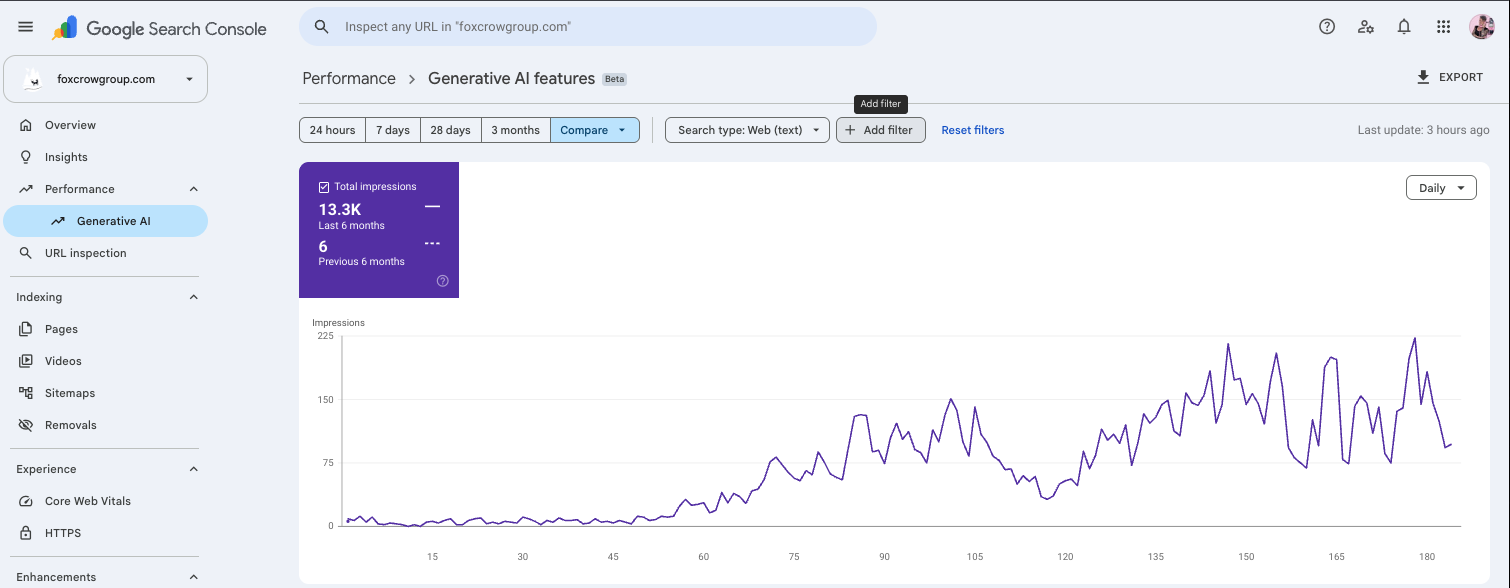 Google Search Console generative AI features report for foxcrowgroup.com: 13.3K impressions in the last 6 months versus 6 in the previous 6 months
It shows up in the rest of our numbers too. In one quarter, with no paid search spend, our organic visibility grew about 10x:
- 10x growth in Google visibility on our core pages. Our lead generation guide went from 2,860 appearances to 34,000.
- 133 of our pages cited as sources in Google's AI-written answers.
- 920 different searches we now appear for, across 222 pages.
- +136% growth in website visits from search.
The people who find us through AI tools are our most engaged visitors: 75% of them engage with the site, against 31% sitewide. We've built a channel to MSP owners that we own and that keeps compounding. As buyers shift from searching to asking AI, we're already one of the sources AI cites.
None of that came from a listing. It came from 18 months of building content that AI systems could read, understand, and cite. A listing is one input. If ChatGPT can't categorize your MSP correctly, your website and your content have to do the explaining.
Revisit your AI and SEO strategy
At Channel Vision Magazine's CVxExpo this fall, I gave a keynote on MSP AI marketing. We went in expecting to talk about MSPs that are all talk on AI and no action. Fox & Crow Instinct data on more than 40,000 MSPs pointed somewhere else:
- About half of MSPs mention AI somewhere on their website.
- About 1 in 5 name it as a service a buyer can buy.
- About 1 in 10 target AI terms in search.
- The most common name for an AI service, "AI consulting," shows up at roughly 52 firms. Nobody owns the category.
That last number is the same problem as the missing ChatGPT category. When MSPs can't agree on what to call what they sell, an AI system has nothing consistent to match a buyer's question to. As I put it on stage: "AI-powered" is a garnish. A buyer can't buy a garnish.
So check three things before you plan next year:
- Does your website say plainly what you sell, to whom, and where? A named service on its own page beats an adjective sprinkled across your homepage.
- Do your listings agree with each other? Your website, Google Business Profile, LinkedIn page, directories, and now your ChatGPT listing should describe the same business.
- Are you targeting the terms buyers use? Titles, meta descriptions, and content that answer specific questions give both Google and AI assistants something to cite.
Instinct also published research on MSP visibility in AI search if you want to dig further.
Sales has to ask better questions than "How did you hear about us?"
Even when AI search does introduce a buyer, your analytics usually can't see it. The buyer reads an answer, doesn't click, and later Googles your name or calls the main line. GA4 calls that direct or branded traffic. Your report says SEO isn't working. Your pipeline might say something else.
"How did you hear about us?" gets you "Google" or "online," which tells you nothing. Have your rep ask these on every inbound call:
- What were you searching for when you found us? Get the actual words.
- Where did you search? Google, ChatGPT, Copilot, Perplexity, something else?
- What did it say about us? This tells you whether the AI has your story right.
- Who else did it suggest? That's your real competitive set.
- Why did you reach out to us instead of them?
Put the answers in real CRM fields, not a call note. If your reps never hear "ChatGPT," that's an answer too. It tells you AI search isn't introducing you yet, and your strategy needs work.
Where Fox & Crow Jackdaw fits
Claiming a listing is one task. Deciding what your MSP publishes for the next twelve months so AI search understands what you do is a bigger job, and most MSPs plan it by guessing.
Fox & Crow Jackdaw helps with your AI marketing strategy and your annual content plan around AI. A Jackdaw reading puts your MSP side by side with the MSPs you lose deals to locally and shows where each of you is visible, trusted, and ready for AI search. You build the year's content plan from what that shows. If you want hands-on help, Jackdaw also offers one-off MSP marketing strategy and fractional MSP marketing leadership, plus a free MSP marketing guide if you'd rather start on your own.
Other AI reading for MSP owners
- Carrie on SmarterMSP: The Hidden AI Marketing Problem in the MSP Industry
- My conversation with Technology Reseller at CVxExpo 2026: MSPs are selling AI, but are they ready to sell it?
- My interview with Authority Magazine on pushing the boundaries of AI
- West McDonald on the economics of AI for MSPs
- Matt Tomlinson on how MSPs are using AI
- Peter Conway on building better business application partnerships
Next step
- Want the full how-to? Learn more on the Jackdaw site.
- Not sure which category fits, or what your AI strategy should look like? Book a marketing strategy review with Carrie Richardson.