
Matt Tomlinson: MSPs Are Using AI. Stop Hiding It.
Listen to this article
Browser text-to-speech
Ask an MSP if they're using AI and most will say not yet.
Ask what's running behind their ticketing system, and the answer changes.
That gap, between what MSPs say in public and what's already running in production, is the real story of the AI transition happening in this channel right now. Not whether the technology works. Whether anyone's willing to say it does.
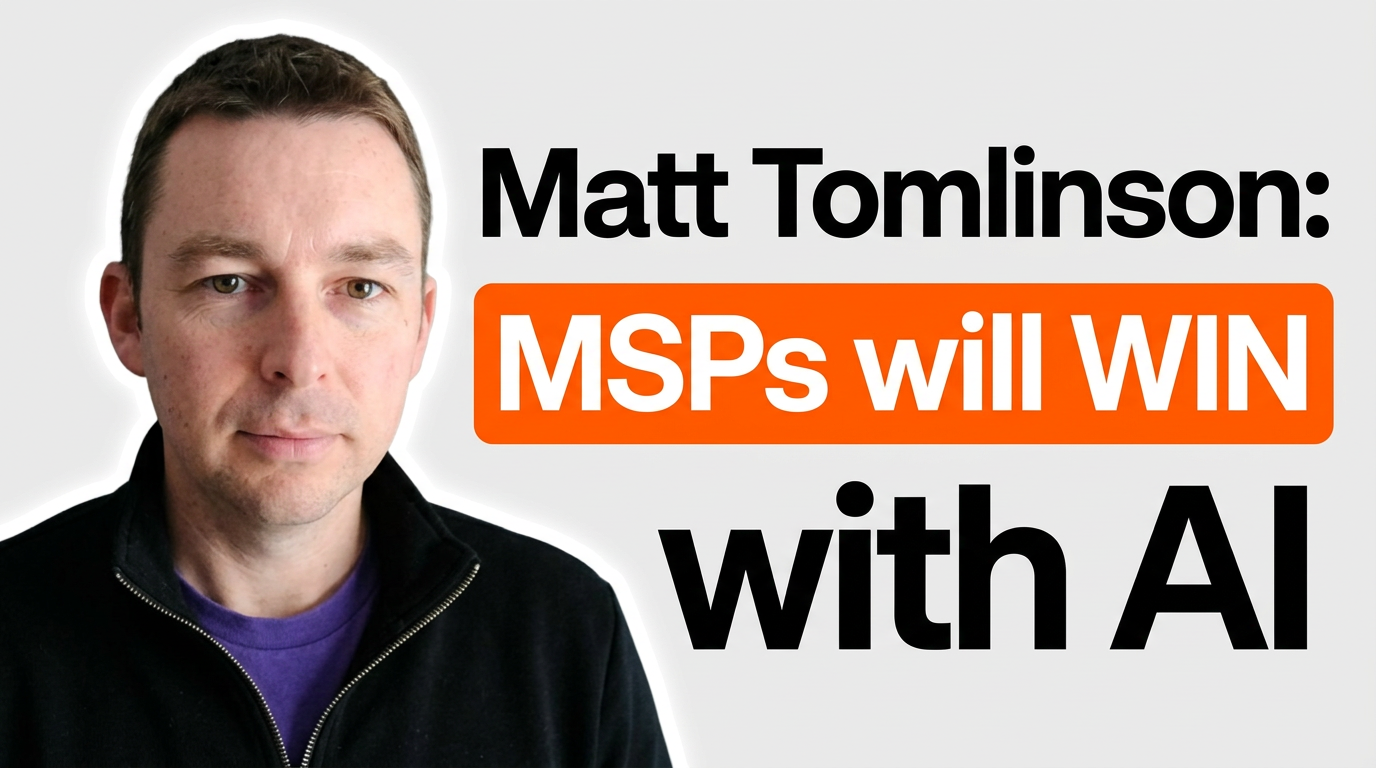
Matt Tomlinson has spent his career on the revenue side of the IT channel, most recently as CRO of CompassMSP, an actual managed service provider, before joining Fixify as senior director of MSP partnerships. Here's how he puts the whole thing:
They're not actually selling that they're using AI. They're selling the outcome. 'Hey, we can solve your tickets 40, 50, 70% faster than the MSP down the street.'
That's the whole pattern in one line. Here's the rest of it.
The Personal Touch Excuse
Tomlinson's read on why MSPs stay off the record comes down to a brand contradiction most of them built for themselves without quite noticing.
There's this mindset that talking to an AI chatbot is painful and impersonal, and it's not what MSPs are selling, right? MSPs are selling the personal touch and feel of their service. But most of the time what people are actually buying is the outcome. They just want their ticket solved, and they want it done quickly.
He tested that idea on himself without meaning to. At a hotel in Vegas, he spent twenty minutes on the phone convinced he was talking to a person, working through a question about his stay. It was an AI chatbot with well-built guardrails, handing him to a human the moment it hit the edge of what it knew. He never noticed the difference until it happened. The chatbot didn't cost the hotel its personal-touch story. It delivered the outcome he wanted, which was an answer.
MSPs have spent years selling a relationship, not a resolution time. Admitting the ticket got solved by a model feels, to a lot of operators, like undercutting the thing they charge for. So they don't say it, even when the customer on the other end mostly wanted the outcome Tomlinson keeps describing, not a person on the phone.
The Caution Is Real. It's Just Not the Whole Reason.
There's a more defensible version of that reluctance, and Tomlinson doesn't dismiss it.
Having been in the MSP space for a long time, new technologies are always risky. The most important thing from an MSP is retention of customers, and it's a tricky thing to go out and find a new product and put it into place without it being really battle-tested.
He's watched this exact caution before, with cloud, with managed detection and response, with the entire security stack that's now standard issue in the channel. Every one of those categories followed the same arc: slow, skeptical adoption, followed by a stretch where running without the technology became the riskier choice. That history makes the caution about the technology legitimate. It doesn't explain why a firm already running AI successfully still won't put it on its own website. That's a different, more specific reluctance than risk aversion, and it's the one costing MSPs the most right now.
Somebody Is Going to Say It Out Loud First
Tomlinson thinks the platforms with investors behind them are the ones most likely to say it first, not the MSPs still weighing the risk to their brand.
The fundamental truth of business is that you're trying to protect EBITDA margins.
A platform answering to investors doesn't carry the same allergy to sounding like a technology company that an owner-operator MSP does. Once one of them claims an AI-driven price advantage in public, with a number attached, every MSP that said nothing stops competing on relationship and starts competing on price against a number it never got to help define.
I'll admit a bias here: Fox & Crow Instinct benchmarked 1,008 MSPs earlier this year and found close to none of them positioning AI publicly, so pointing to our own data to make this argument is convenient for us. Take it with that in mind. It's also exactly the kind of gap a well-funded competitor moves fastest to fill, whether or not we'd published a word about it.
Say the Specific Thing You Already Did
Tomlinson's advice for what to publish instead had nothing to do with explaining artificial intelligence to anybody.
Focus on real-world problems that people are running into. It's not always about the technology, right? It's like, how do you use the technology, and how does that technology become relevant to your current business model?
He pointed to an MSP that helped a law firm restructure its billing after AI made the firm more efficient internally. The firm was suddenly billing fewer hours for the same delivered value, so the MSP helped rework the pricing to capture the time savings instead of losing revenue to its own efficiency gains. That's a business story with AI inside it, not an AI story, and it's a sharper piece of content than another explainer on what large language models are.
For the other side of that commercial question — how MSPs can turn AI into a service customers will pay for — read West McDonald on the economics of AI.
What Separates the MSPs Already Positioned From Everyone Else
This comes down to three decisions, and none of them require new technology to make.
- Whether you'll say what's already running. Most of the AI adoption gap in this channel is a disclosure gap, not a technology gap.
- Whether the personal-touch pitch gets to veto the truth. Customers are buying the outcome. Tomlinson's own experience with a hotel chatbot proves they often can't tell the difference, and don't mind when they can.
- Whether you publish before a better-funded competitor does. The MSPs waiting for certainty are handing a still-open argument to whoever has the least to lose by claiming it first.
Tomlinson goes deeper on where AI pricing and homegrown AI builds are headed, including his prediction for 2027, in the full conversation on WIN. Find him at IT Nation this year, or learn more about how Fixify resolves tier-one tickets at fixify.com.
If you want to see where your own MSP sits in the visibility gap Tomlinson is describing, Fox & Crow Instinct's benchmark walks through the same data referenced above. If you need help building the content and positioning system to compete for this category, that's what we do at Fox & Crow Group. Book a call to talk through where your MSP stands today.
FAQ
Why don't more MSPs talk publicly about using AI?
Most MSPs sell a personal-touch relationship, and admitting a ticket got resolved by AI feels to a lot of operators like it undercuts that pitch. Matt Tomlinson of Fixify says the hesitation is less about the technology and more about protecting a sales story that customers, in practice, care about less than the outcome.
Is it risky for an MSP to admit it uses AI for support tickets?
Not inherently. Customers overwhelmingly want the outcome, a resolved ticket, delivered quickly, more than they care whether a person or a model handled it. The real risk is in deployment without guardrails, not in disclosure.
What should MSPs publish about AI instead of generic explainers?
A specific outcome: one ticket resolved faster, one workflow automated, one customer problem solved differently than it would have been a year ago, with a number attached. Tomlinson's advice is to write about the business problem AI solved, not about the technology itself.
Who is positioned to win the AI pricing argument first?
Private-equity-backed MSP platforms, according to Tomlinson, because protecting investor margins gives them less reason to stay quiet about using AI to cut costs. MSPs that wait to say anything are likely to end up negotiating against a price advantage they never got to help define.
How many MSPs currently have visible AI positioning?
Fewer than 2% of the 1,008 MSPs Fox & Crow Instinct benchmarked in May 2026 had substantive AI advisory positioning, and zero of the 571 fully assessed firms had structured AI as a named service offering.