
MSP Sales Accountability
Listen to this article
Browser text-to-speech
MSP Sales Accountability
MSP sales accountability issues start from the top down.
Most MSP sales problems don’t come from lazy reps.
They come from a lack of real accountability, fake pipeline, wasted meetings, and zero clarity.
If you’re a founder-led MSP sick of being the one hauling the sales bag every quarter, this is for you.
What Is MSP Sales Accountability?
MSP sales accountability is a role-based system that connects revenue targets to pipeline health and required activity—so leaders can coach the right constraint instead of arguing about effort.
MSP Sales Accountability Framework
To make MSP sales accountability real (and sustainable), keep the system MECE—mutually exclusive and collectively exhaustive:
-
Diagnose: Use the decision tree to isolate the constraint (revenue → pipeline → activity).
-
Define: Set role-specific scorecards (new logo vs. account management).
-
Enforce: Run meeting rhythms that surface truth and apply consistent consequences.
-
Implement: Follow a 90-day rollout so behavior becomes muscle memory.
What Breaks MSP Sales Accountability
In our masterclass, we unpacked a no-fluff decision tree that forces focus on what actually moves the number: revenue,** pipeline**, and** activity**.
You’ll find the replay, highlights, a field-tested case study, and how to prep for the next live session below.
On-Demand: Replay + Highlights
If you missed the opportunity to watch our live masterclass on MSP sales accountability, you can still catch the replay.
[
WATCH THE FULL REPLAY HERE
](https://zoom.us/webinar/register/3017556229530/WN_zLf51n1SQ2CgiLpVlshXFQ#/registration)
Passcode: C*0+hUka
Webinar Highlight:
Sorry, your browser doesn’t support embedded videos.
“Accountability fails when targets aren’t clear or broken down by role. Your sales execs can’t own the goal if they don’t understand how to hit it, and tracking activity alone won’t fix that.” — Ian Richardson
This is the trap most founder-led MSPs fall into: confusing motion for progress. Real accountability requires clear targets, role-specific scorecards, and activity that maps to outcomes.
From the Field: Real MSPs, Real Wins
Our post Accountability isn't a buzzword sparked more DMs from MSP owners than anything else we’ve written.
Turns out, “just do more dials” isn’t cutting it anymore. Leaders want clarity. A system. A way to know if their team is actually selling—or just doing “sales stuff.” That’s why the MSP Sales Decision Tree works.
Want proof? Look at Brightworks IT. They went from constant rep churn and outsourced lead gen that flopped to a consistent, trackable pipeline.
“Brightworks tried outsourcing lead gen and hiring reps without success. Then they turned to the MSP Sales Process, and everything changed.”
Read the full Brightworks case study to see how accountability and structure changed their growth trajectory.
The MSP Sales Decision Tree
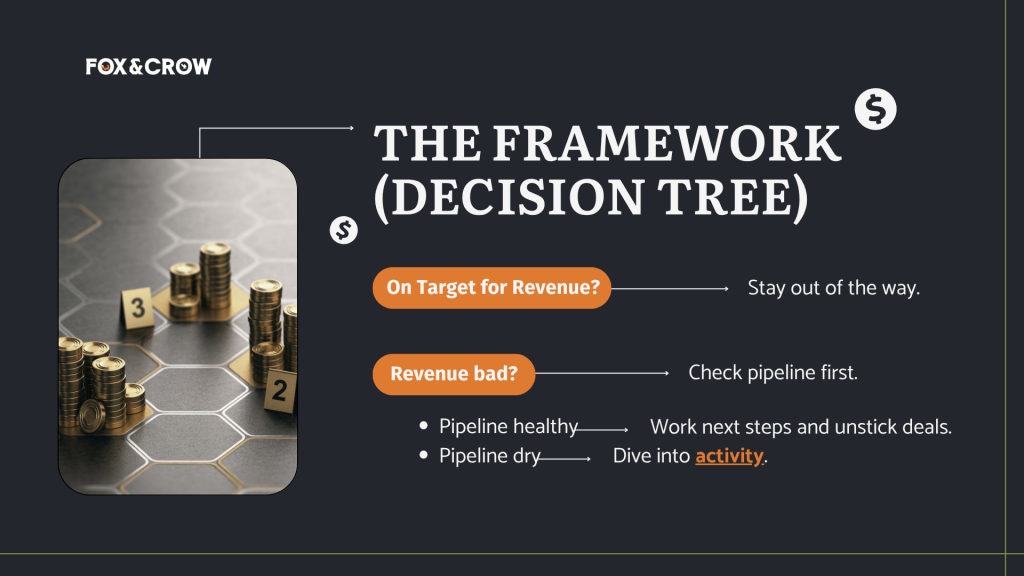
The MSP Sales Decision Tree is the backbone of** MSP sales accountability**: it connects outcomes, effort, and the truth in your pipeline.
Diagnose: The 3-Step Accountability Flow
Step 1: Revenue on target?
Yes: get out of the way and let them run. No: move to pipeline.
Step 2: Pipeline healthy?
Yes: work next steps. Every deal must have an owner, a next-step date, a value, and a decision maker mapped. No: move to activity.
Step 3: Activity real and sufficient?
Check calendars, dial counts, and talk time. Kill internal meeting bloat and coach to conversion.
You can build coaching sessions, reporting, and weekly 1:1s around this flow.
Define: Real Pipeline (Not Hope)
Every deal in your CRM should filter out fake deals. Every deal in your pipeline should match up against the five key qualifiers:
-
Company size (20+ users)
-
They already invest in IT (internal or MSP)
-
Relationship length (in years)
-
Relationship health score (1–10) plus what makes it a 10
-
Decision maker’s full info (name, title, phone, email)
“Hope is not a valid business development strategy.”
If it doesn’t hit all five, that’s not a deal. That’s a fantasy.
Define: Activity Math That Actually Lands Customers
Here’s what the numbers say across hundreds of MSPs:
-
About 18 touches equals 1 first-time appointment (FTA).
-
About 300 to 400 dials equals 1 FTA (from a clean list).
A rep averaging 100 dials per day typically produces about 4 FTAs per month, 3 proposals, and 1 new logo per month (at about a 30% close rate).
Sales cycle should stay under 75 days. Beyond that, win rates drop about 60%.
If the effort is there but results aren’t, don’t throw pressure. Throw coaching.
-
Review call recordings for missed cues.
-
Run live monitoring blocks and coach in real time.
-
If FTAs happen but closes don’t, it is usually a discovery problem.
See how MSP sales accountability improved MSP sales results in this case study: how we sell managed IT .
Define: Scorecards That Drive Sales
New Logo (Sales Executive)
-
Monthly MRR target
-
Dials per day
-
FTAs per month
-
Qualified deal count (no fake opps)
-
Sales cycle of 75 days or less
Account Management (Farmer)
-
MRR and NRR targets
-
Attach rate of 20% or higher (about 1 opportunity per 5 customers per quarter)
-
Communication cadence compliance by tier (High, Medium, Low)
Reminder: AMs sell. They do not babysit service issues. That is service desk turf.
Enforce: Meetings That Make MSP Sales Accountability Real
-
Monthly team sales meeting: Public scorecards, wins, pipeline exceptions, and next steps. Competition fuels performance.
-
Weekly 1:1s: Use the decision tree. If revenue is green, wrap in 10 minutes. If not, dig deep.
-
Two misses in a row: Performance Improvement Plan. No exceptions.
“Nothing demotivates your best rep faster than tolerating your worst.”
These rhythms keep MSP sales accountability visible, measurable, and consistent.
Implement: MSP Sales Implementation Checklist (90-Day Ramp)
| Week | Focus | Outcomes |
|---|---|---|
| 1–2 | Define MRR targets by role, set scorecards, build qualification checklist | Clear benchmarks |
| 3–4 | Live dial blocks, remove internal meeting bloat | Consistent activity |
| 5–8 | Coach to discovery and proposals | Conversion improvements |
| 9–12 | Enforce “stalled means no next step within 14 days” | Predictable forecasting |
By day 90, you should have green scorecards and the muscle memory to sustain them.
Pipeline Health Mini-Template (Copy/Paste)
Paste this into your CRM notes for every active opportunity:
-
Deal name, value, and close date
-
Decision maker and influencers mapped
-
All five qualification fields completed
-
Next step owner, date, and expected outcome
-
Status: Green, Yellow, or Stalled (no next step within 14 days)
If a deal is stalled, it is not forecastable. Period.
Watch the Replay (Why It Beats the Recap)
Reading this gives you the framework. Watching the session shows how it works in the real world.
Here’s what you’ll see on the replay:
-
Live deal teardown: turning stuck pipeline into action plans
-
Real call coaching: what to say when prospects stall
-
Qualification 5 applied live
-
Discovery analysis for faster closes
-
No-BS Q&A: how to hold reps accountable without blame
For upcoming events and session notes, join the Fox & Crow LinkedIn community.
Accountability That Sticks (Without Burning Reps)
Accountability is not about punishment. It is protection.
When expectations, numbers, and consequences are clear, your team performs better, faster, and happier.
How to enforce accountability the right way:
-
Green: Autonomy and bonus. Celebrate wins across the company.
-
Yellow: Coaching plan and short-term education.
-
Red (2 months): Performance Improvement Plan or part ways.
You can’t motivate someone into success without structure. The decision tree is that structure.
Book Your Accountability Planning Session
Last time we offered 5 spots, they filled up in 72 hours. We’ve opened rolling sessions for MSPs ready to get serious about MSP sales accountability.
In this 60-minute session, we will:
-
Build or fix your scorecards
-
Apply “Qualification 5” to your live pipeline
-
Audit your sales rhythm
-
Lock in a plan for 2026 growth targets
Book:
FAQ
What is MSP sales accountability?
MSP sales accountability is a role-based operating system that ties revenue targets to pipeline requirements and activity expectations. It makes performance measurable and coachable using scorecards, deal standards, and consistent meeting rhythms.
How long until a new rep starts closing monthly?
Many MSPs see a ramp like this: early phone work in week 3, discovery in month 2, consistent FTAs by month 3, and closed deals commonly showing up by about month 6.
What qualifies as a stalled deal?
A deal is stalled when there is no next step scheduled within 14 days. If there is no owned next step, it is not forecastable.
What attach rate should account managers hit?
At least 20%. That is roughly one new opportunity per 5 customers per quarter.
What is the single habit that keeps accountability from fading?
Doing what you said you would do. Review scorecards weekly and act on them monthly with consistent coaching and consequences.